Inventory Accounting for Nairobi Second-Hand Car Dealers
By Adamjee AuditorsPublished June 2, 20266 min read
Quick Answer
Nairobi second-hand car dealers should treat every vehicle as a separate financial asset tracked by VIN, valued using specific identification, with all landed and refurbishment costs correctly capitalized. From 1 January 2026, all expenses must be supported by valid eTIMS invoices or they are disallowed for tax.
Key Takeaways
Treat each vehicle as an individual asset tracked by its VIN, with its own acquisition, import, clearing, and refurbishment costs rather than pooled stock.
Use specific identification for valuation, as no two used vehicles share identical cost structures; FIFO has limited use and weighted average is not suitable.
Capitalize full landed cost (purchase price, freight, import and excise duty, port and clearing fees, insurance, forex differences) into inventory value to avoid overstated profits.
Classify refurbishment correctly: capitalize major work like engine overhauls, body repairs, transmission replacement, and full repainting; expense minor servicing, cleaning, and yard maintenance.
From 1 January 2026, all dealership expenses must be backed by valid eTIMS invoices, with VIN-based digital inventory systems replacing manual spreadsheets.
Why accounting for car dealerships Kenya determines profitability
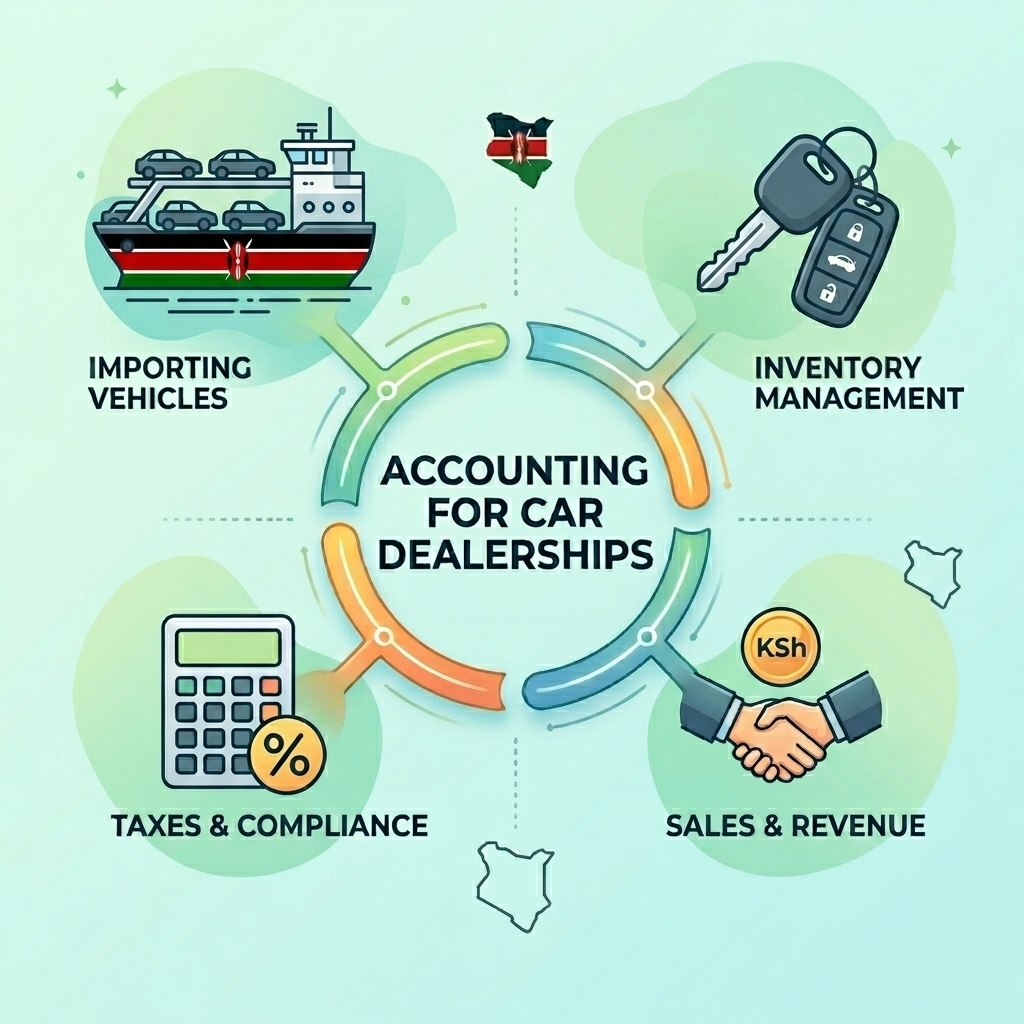
accounting for car dealerships Kenya is a critical financial discipline that determines profitability, tax compliance, and long-term sustainability in the used car industry. In Nairobi’s second-hand vehicle market, each unit is a high-value, individually unique asset with its own landed cost, import duty structure, refurbishment requirement, and resale margin.
For dealers handling imported vehicles (“mitumba for cars”), accounting for car dealerships Kenya is not just bookkeeping. It is a structured financial system that ensures accurate inventory valuation, correct profit reporting, and full compliance with Kenya Revenue Authority (KRA) requirements.
With the 2026 enforcement of eTIMS invoice validation, digital audit trails, and automated compliance checks, accounting for car dealerships Kenya has become a core operational requirement rather than an optional accounting function.
Accounting for car dealerships Kenya: Understanding inventory fundamentals
accounting for car dealerships Kenya requires treating every vehicle as a separate financial asset rather than pooled stock. Each car has a unique cost structure influenced by purchase price, shipping, customs duty, and refurbishment expenses.
Proper accounting for car dealerships Kenya ensures accurate tracking of:
Acquisition cost per vehicle
Import and clearing charges
Refurbishment and repair costs
Selling price and gross margin
Each vehicle must be tracked using its Vehicle Identification Number (VIN), supported by import documentation and cost breakdowns.
Accounting for car dealerships Kenya: valuation methods for used vehicles
accounting for car dealerships Kenya relies heavily on accurate inventory valuation. The most suitable method is specific identification, where each vehicle is tracked individually from purchase to sale.
This is necessary because no two vehicles share identical cost structures or conditions.
Method
Suitability
Accuracy
Application
Specific Identification
High
Very High
Recommended
FIFO
Moderate
Medium
Limited use
Weighted Average
Low
Low
Not suitable
Accurate valuation ensures accounting for car dealerships Kenya reflects true cost of goods sold (COGS) and aligns with IFRS reporting standards.
Accounting for car dealerships Kenya: landed cost and import valuation
accounting for car dealerships Kenya begins with accurate landed cost calculation. Landed cost represents the total cost of acquiring and preparing a vehicle for resale in Kenya.
It includes:
Purchase price of the vehicle
Freight and shipping charges
Import duty and excise duty
Port and clearing fees
Insurance costs
Foreign exchange differences
For example, a vehicle purchased at KES 800,000 may exceed KES 1.4 million after all import-related costs.
Proper accounting for car dealerships Kenya ensures all landed costs are correctly capitalized into inventory value. Failure to do so leads to overstated profits and tax misreporting.
Accounting for car dealerships Kenya: complete inventory management system
A complete accounting for car dealerships Kenya system integrates inventory tracking, financial reporting, and tax compliance into one structured framework.
Key components include:
Automated VIN-based inventory tracking
Integrated accounting software
Monthly reconciliation processes
eTIMS validation system
Real-time profit monitoring
This ensures full financial transparency and regulatory compliance across all dealership operations.
As businesses scale, supporting systems such as payroll and bookkeeping become essential, available through Payroll Services and Bookkeeping Services.
Accounting for car dealerships Kenya: common accounting mistakes
accounting for car dealerships Kenya is often affected by recurring financial errors that distort profitability and trigger compliance risks.
Common mistakes include:
Understating landed costs
Misclassifying refurbishment expenses
Missing eTIMS invoices
Weak VIN-level tracking
Mixing personal and business assets
Incorrect inventory valuation
These issues frequently lead to KRA audit adjustments and tax penalties.
Conclusion: strategic importance of accounting for car dealerships Kenya
accounting for car dealerships Kenya is no longer a basic bookkeeping function. It is a strategic financial control system that determines profitability, compliance, and long-term business sustainability.
With stricter eTIMS enforcement, IFRS requirements, and automated KRA audits, businesses must adopt structured, technology-driven accounting systems.
Proper accounting for car dealerships Kenya ensures:
Accurate profitability measurement
Strong tax compliance
Reduced audit risk
Improved financial control
Gain Clarity and Confidence in Your Finances Navigate the complexities of compliance, tax, and financial management with a trusted partner. Adamjee Auditors, a member of Santa Fe Associates International (SFAI), provides world-class audit, tax, and advisory services to help your business achieve its goals.
Schedule a consultation with our expert team in Nairobi or Mombasa to discuss your business needs.
Nairobi Office
1st Floor, Le’Mac Building, Church Road, off Waiyaki Way, Westlands
What inventory valuation method should Kenyan used-car dealers use?
Specific identification is the recommended method because each vehicle is tracked individually from purchase to sale and no two cars share identical cost structures or condition. FIFO has only limited use and weighted average is not suitable for this industry.
What costs make up a vehicle's landed cost?
Landed cost includes the purchase price, freight and shipping, import and excise duty, port and clearing fees, insurance, and foreign exchange differences. For example, a vehicle bought at KES 800,000 may exceed KES 1.4 million after all import-related costs.
Which refurbishment costs are capitalized versus expensed?
Capitalize major work such as engine overhauls, major body repairs, transmission replacement, and full repainting because it adds to inventory value. Expense minor servicing, yard maintenance, cleaning, and administration. Incorrect classification distorts statements and can trigger tax adjustments.
How does eTIMS affect car dealership accounting in 2026?
From 1 January 2026, all expenses including vehicle purchases, import costs, refurbishment, and operational costs must be supported by valid eTIMS invoices. Any unsupported cost is automatically disallowed for tax, and accounting must align with real-time VAT reporting and digital audit trails.
What are the most common accounting mistakes for Nairobi car dealers?
Common mistakes include understating landed costs, misclassifying refurbishment expenses, missing eTIMS invoices, weak VIN-level tracking, mixing personal and business assets, and incorrect inventory valuation. These frequently lead to KRA audit adjustments and tax penalties.