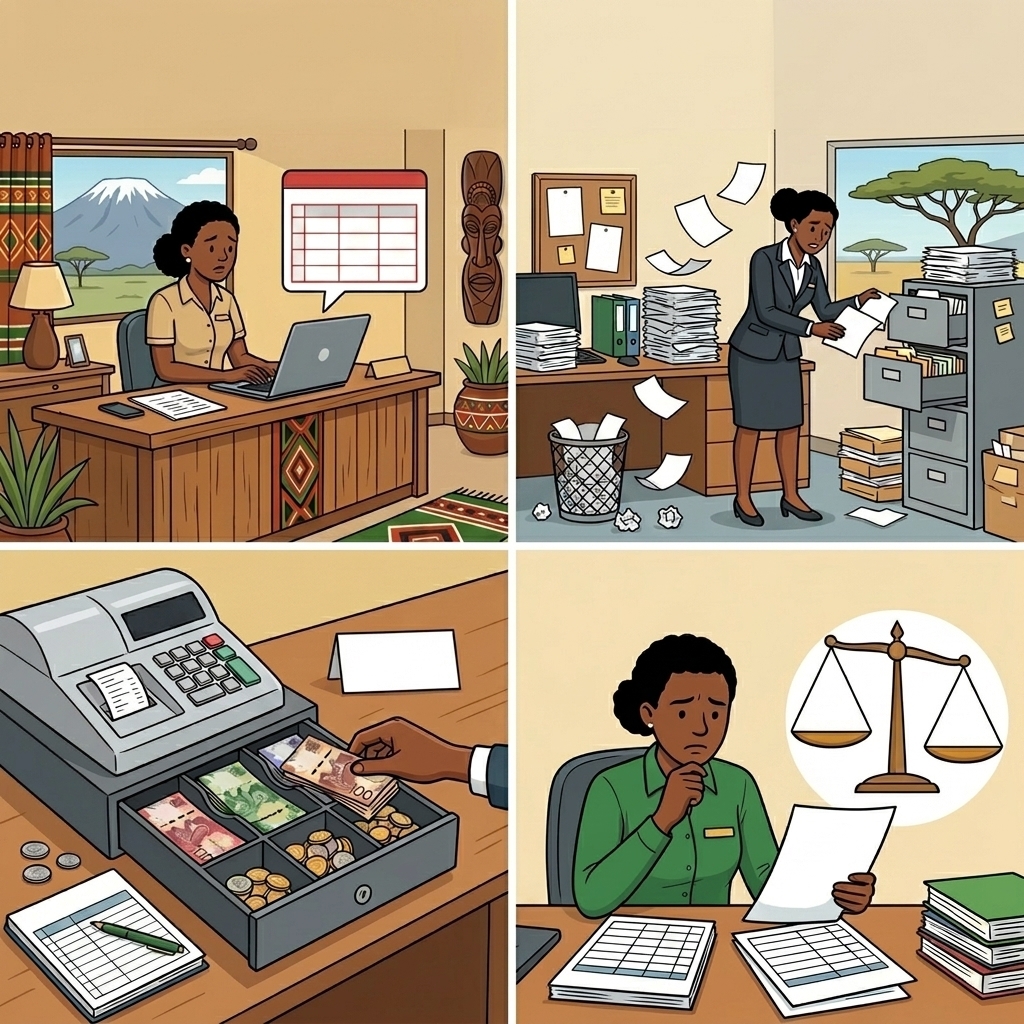
- Separate accommodation, restaurant, bar, and events revenue so loss-making departments do not stay hidden behind overall profit.
- Plan for seasonality: peak and low occupancy swings cause cash flow shortages when staffing and spending stay fixed.
- Tighten cash handling across POS, mobile money, and front-office collections to stop unrecorded sales and shift-reconciliation leakage.
- Track food and beverage Cost of Goods Sold to expose wastage, inventory losses, and inflated margins in kitchens and bars.
- Maintain complete tax documentation (supplier invoices, VAT tracking, expense records) to avoid disallowed expenses, penalties, and audit exposure.
Hotels and resorts in Malindi operate in one of the most volatile but opportunity-rich sectors in Kenya’s economy: coastal tourism. The issue of hotel bookkeeping mistakes hospitality kenya is not just an accounting concern—it directly determines survival, profitability, and compliance.
When hotel bookkeeping mistakes hospitality kenya occur repeatedly, they create:
- hidden revenue leakage
- distorted profit reporting
- tax compliance risks
- poor cash flow forecasting
In Kenya’s tourism sector, especially in coastal regions like Malindi, weak financial systems often hide operational inefficiencies until they become critical.
1. Hotel Bookkeeping Mistakes Hospitality Kenya: Mixing Room and F&B Revenue
One of the most common hotel bookkeeping mistakes hospitality kenya is failing to separate revenue streams between accommodation and food & beverage operations.
Hotels often combine:
- room revenue
- restaurant sales
- bar income
- events income
Why this is a critical error
When hotel bookkeeping mistakes hospitality kenya include revenue mixing:
- profitability by department becomes invisible
- management cannot identify loss-making units
- pricing strategies become inaccurate
For example, a hotel may appear profitable overall but may actually be subsidizing a loss-making restaurant operation.
Structured bookkeeping systems such as
Bookkeeping Services help eliminate these errors.
2. Hotel Bookkeeping Mistakes Hospitality Kenya in Seasonal Revenue Planning
Another major hotel bookkeeping mistakes hospitality kenya issue is ignoring seasonality in financial planning.
Malindi hotels experience:
- peak tourist seasons
- low occupancy months
- irregular international demand
Financial impact
When hotel bookkeeping mistakes hospitality kenya include poor forecasting:
- hotels overspend during low season
- staffing costs remain fixed
- cash flow shortages become common
This makes survival dependent on peak-season revenue rather than financial planning discipline.
Advanced financial oversight through
CFO Advisory Services helps stabilize seasonal fluctuations.
3. Hotel Bookkeeping Mistakes Hospitality Kenya in Cash Handling
Cash handling errors are among the most damaging hotel bookkeeping mistakes hospitality kenya.
Hotels in Malindi rely heavily on:
- cash payments
- POS transactions
- mobile money
- front office collections
Where leakage occurs
- unrecorded cash sales
- weak shift reconciliation
- manual adjustments without documentation
These issues accumulate into significant revenue loss over time.
Strong governance frameworks supported by
Company Secretarial Services help enforce accountability.
4. Hotel Bookkeeping Mistakes Hospitality Kenya in Food & Beverage Cost Tracking
Failure to track Cost of Goods Sold (COGS) is another major hotel bookkeeping mistakes hospitality kenya challenge.
Without proper tracking:
- food wastage goes unnoticed
- inventory losses remain hidden
- profit margins are inflated
Hotels often underestimate how much leakage occurs in kitchens and bars.
Audit systems such as
Audit and Assurance Services help identify inefficiencies.
5. Hotel Bookkeeping Mistakes Hospitality Kenya in Tax Documentation
Incomplete documentation is a recurring hotel bookkeeping mistakes hospitality kenya issue in coastal hotels.
Common problems include:
- missing supplier invoices
- informal casual payments
- weak VAT tracking
- poor expense recording
Compliance impact
This leads to:
- disallowed expenses
- tax penalties
- audit exposure
In Kenya’s current tax environment, digital verification systems increase detection of inconsistencies.
Support is available through
Tax Compliance Advisory Services.
6. Payroll-Related Hotel Bookkeeping Mistakes Hospitality
Payroll inefficiencies are often hidden but significant hotel bookkeeping mistakes hospitality issues.
Problems include:
- overtime miscalculations
- casual worker inconsistencies
- ghost shifts
- informal wage payments
Payroll leakage directly reduces profitability.
Structured payroll management through
Payroll Services improves control.
7. Integration Failures in Hotel Systems
Many hotel bookkeeping mistakes hospitality kenya arise from poor integration between booking systems and accounting software.
This results in:
- inconsistent revenue reports
- delayed reconciliation
- inaccurate financial statements
8. Lack of Reporting Discipline in Hospitality Accounting
Another major hotel bookkeeping mistakes hospitality issue is absence of structured reporting.
Without monthly reports:
- management decisions are reactive
- financial risks remain hidden
- profitability cannot be tracked properly
Conclusion: Fixing Hotel Bookkeeping Mistakes Hospitality
Most hotel bookkeeping mistakes hospitality are not technical errors—they are system design failures.
When properly addressed, hotels benefit from:
- accurate profitability tracking
- improved cash flow management
- reduced tax exposure
- stronger operational control
Fixing these issues is essential for long-term sustainability in Malindi’s competitive hospitality market.
Gain Clarity and Confidence in Your Finances Navigate the complexities of compliance, tax, and financial management with a trusted partner. Adamjee Auditors, a member of Santa Fe Associates International (SFAI), provides world-class audit, tax, and advisory services to help your business achieve its goals.
Schedule a consultation with our expert team in Nairobi or Mombasa to discuss your business needs.
Nairobi Office
1st Floor, Le’Mac Building, Church Road, off Waiyaki Way, Westlands
+254 717 908 241
Mombasa Office
Suite 401, Motorwalla Building, Jomo Kenyatta Road
+254 703 899 606 / +254 717 908 241