Reconciling M-Pesa Business Statements with Accounting Records
By Adamjee AuditorsPublished May 28, 20265 min read
Quick Answer
M-Pesa business statement reconciliation is the process of matching Safaricom Till and Paybill statements against cashbooks, ledgers, accounting software and bank deposits so every transaction is captured, classified and matched, ensuring accurate reporting and KRA compliance.
Key Takeaways
Reconciliation matches M-Pesa Till and Paybill statements with bank deposits, cashbook entries and accounting software records so all inflows and outflows are accurately recorded.
Common errors include missing entries, duplicate entries, timing differences between real-time M-Pesa and batched accounting, unrecorded service charges, and cash withdrawals not matched to deposits.
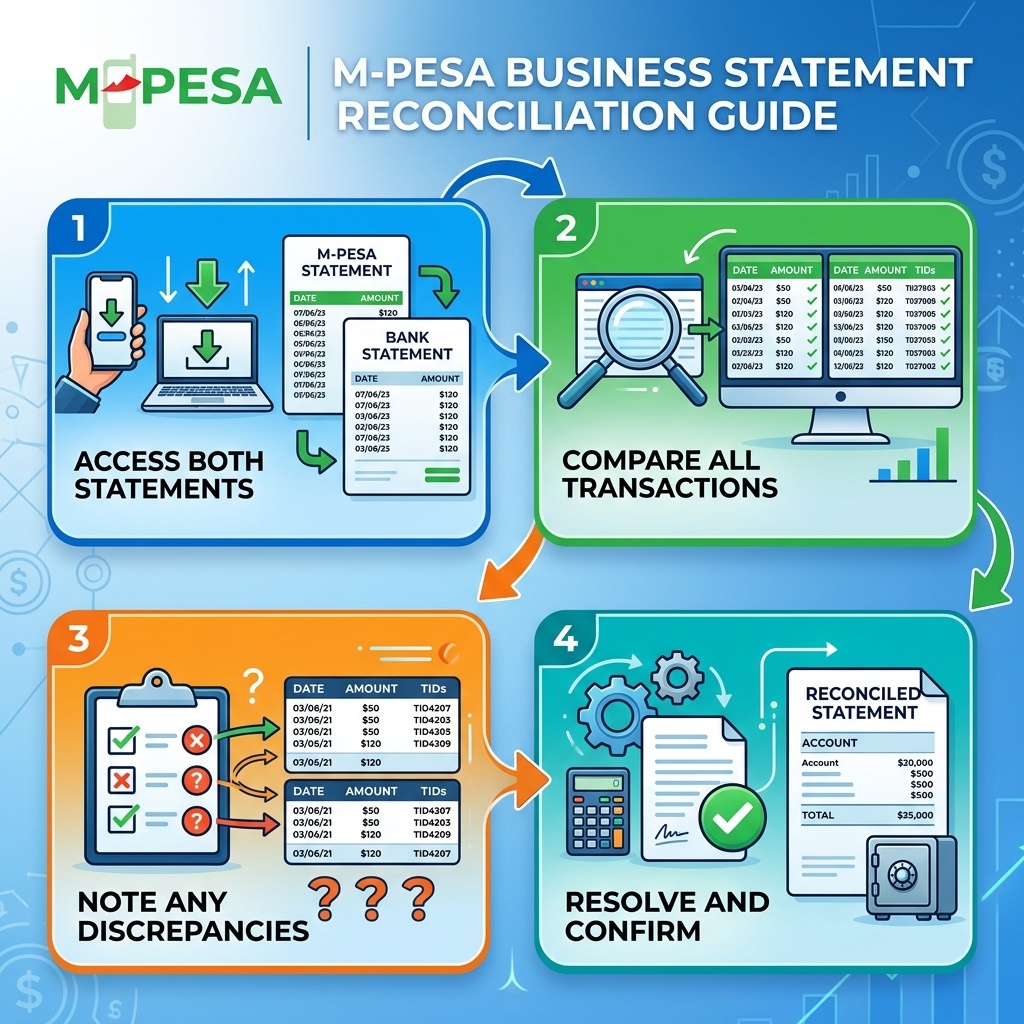
The step-by-step process is: download statements, categorize transactions, match to sales records, record fees separately, reconcile with the cashbook, investigate variances and update accounting software.
M-Pesa transactions must be classified correctly as income (sales and service), expenses (charges, refunds, withdrawals) and asset movements (transfers between mobile money and bank).
Accurate reconciliation supports correct income declaration, VAT reporting and audit evidence; inconsistent M-Pesa records are a common trigger for KRA tax audits.
MPESA Business Statement Reconciliation Guide for Kenyan Businesses
mpesa business statement reconciliation guide is essential for Kenyan businesses that rely on M-Pesa Till and Paybill transactions to manage daily sales and expenses. Without proper reconciliation between M-Pesa statements and accounting records, businesses risk inaccurate financial reporting, missing income entries, and compliance issues with KRA.
In Kenya’s digital economy, M-Pesa is the primary transaction channel for SMEs, retail shops, restaurants, and service providers. However, while transactions are processed instantly on M-Pesa, many businesses fail to properly record and match them in their accounting systems.
This leads to mismatches between:
M-Pesa business statements
Cashbooks and ledgers
Accounting software records
Bank deposits
A structured mpesa business statement reconciliation guide ensures that every transaction is correctly captured, classified, and matched to financial records, improving accuracy, compliance, and financial control.
M-Pesa reconciliation is the process of matching:
M-Pesa Till / Paybill statements
Bank deposits
Cashbook entries
Accounting software records
The goal is to ensure all inflows and outflows are accurately recorded and matched.
Key Data Sources
To perform reconciliation, businesses must gather:
Daily M-Pesa statements from Safaricom
Accounting software reports
Bank statements (for settled funds)
Sales records / invoices
Expense logs
Without structured reconciliation, financial statements become unreliable.
MPESA Business Statement Reconciliation Guide: Common Sources of Errors
Most mismatches in mobile money accounting come from predictable issues.
1. Missing Transaction Entries
Some sales are recorded in M-Pesa but not entered into accounting software.
2. Duplicate Entries
Transactions are accidentally recorded twice during manual bookkeeping.
3. Timing Differences
M-Pesa reflects real-time transactions, while accounting systems may batch entries.
4. Service Charges and Fees
Transaction charges are often not recorded correctly in ledgers.
5. Cash Withdrawals Not Recorded Properly
Till withdrawals may not match bank deposits or cashbooks.
These issues make mobile money bookkeeping workflows Kenya critical for financial accuracy.
MPESA Business Statement Reconciliation Guide: Step-by-Step Process
A structured reconciliation process ensures accuracy and compliance.
Step 1: Download Daily or Monthly M-Pesa Statements
Access statements from the Safaricom business portal.
Step 2: Categorize Transactions
Separate:
Sales receipts
Withdrawals
Refunds
Charges and fees
Step 3: Match Transactions to Sales Records
Align each M-Pesa transaction with invoices or sales entries.
Step 4: Record Service Fees Separately
Ensure charges are recorded as business expenses.
Step 5: Reconcile with Cashbook or Ledger
Match total inflows and outflows with accounting records.
Step 6: Identify and Investigate Variances
Any mismatch should be reviewed immediately.
Step 7: Update Accounting Software
Ensure final reconciled figures reflect accurate financial positions.
MPESA Business Statement Reconciliation Guide: Syncing Lipa na M-Pesa with Accounting Software
Modern businesses integrate M-Pesa directly into accounting systems.
Integration Benefits
Automatic transaction capture
Reduced manual entry errors
Real-time financial reporting
Faster reconciliation cycles
Popular Sync Methods
API integration with accounting systems
CSV import from M-Pesa statements
Third-party payment integration tools
Proper sync lipa na mpesa with accounting software systems reduce reconciliation time significantly.
MPESA Business Statement Reconciliation Guide: Accounting Treatment of M-Pesa Transactions
From an accounting perspective, M-Pesa transactions must be properly classified.
Income Entries
Sales revenue from customers
Service income
Mobile payments received
Expense Entries
Transaction charges
Refunds
Withdrawals to cash accounts
Asset Movements
Transfers between mobile money and bank accounts
Correct classification ensures accurate financial reporting and compliance.
Businesses often use structured bookkeeping services to manage this process efficiently.
MPESA Business Statement Reconciliation Guide: Internal Controls for Accuracy
MPESA Business Statement Reconciliation Guide: Automation and Digital Tools
Automation is transforming mobile money accounting.
Key Features of Modern Tools
Automatic transaction matching
Real-time dashboards
Expense categorization
Bank reconciliation integration
Cloud-based reporting
These systems improve accuracy and reduce workload.
MPESA Business Statement Reconciliation Guide: Common Business Mistakes
Many SMEs in Kenya make avoidable reconciliation errors:
Ignoring transaction fees
Failing to reconcile daily
Mixing personal and business transactions
Poor documentation of withdrawals
Lack of audit trail retention
These mistakes result in inaccurate financial statements.
MPESA Business Statement Reconciliation Guide: Benefits of Proper Reconciliation
Proper reconciliation leads to:
Accurate financial reporting
Better cash flow management
Improved decision-making
Strong audit readiness
Reduced financial risk
It is a core function of financial discipline in modern Kenyan businesses.
Conclusion: Building Financial Accuracy Through M-Pesa Reconciliation
In today’s digital economy, M-Pesa is the primary financial channel for many Kenyan businesses. Without proper reconciliation, financial records become unreliable and decision-making becomes risky.
Implementing a structured mpesa business statement reconciliation guide, supported by accounting systems and internal controls, ensures accuracy, transparency, and compliance.
Businesses that consistently reconcile their M-Pesa records are better positioned for growth, funding, and long-term financial stability.
Gain Clarity and Confidence in Your Finances Navigate the complexities of compliance, tax, and financial management with a trusted partner. Adamjee Auditors, a member of Santa Fe Associates International (SFAI), provides world-class audit, tax, and advisory services to help your business achieve its goals.
Schedule a consultation with our expert team in Nairobi or Mombasa to discuss your business needs.
Nairobi Office
1st Floor, Le’Mac Building, Church Road, off Waiyaki Way, Westlands
It is the process of matching M-Pesa Till and Paybill statements with bank deposits, cashbook entries and accounting software records to ensure all inflows and outflows are accurately recorded and matched.
What are the most common reconciliation errors?
Common errors include missing transaction entries, duplicate entries, timing differences between real-time M-Pesa and batched accounting systems, service charges not recorded correctly, and cash withdrawals not matched to bank deposits or cashbooks.
What are the steps to reconcile M-Pesa statements?
Download daily or monthly statements from the Safaricom portal, categorize transactions, match them to sales records, record service fees separately, reconcile with the cashbook or ledger, investigate any variances, then update accounting software with reconciled figures.
How should M-Pesa transactions be classified in the accounts?
Sales and service payments received are income, transaction charges, refunds and cash withdrawals are expenses, and transfers between mobile money and bank accounts are asset movements. Correct classification ensures accurate reporting and compliance.
Why does M-Pesa reconciliation matter for KRA compliance?
Accurate reconciliation ensures correct income declaration, supports VAT reporting and provides audit evidence, while inconsistent M-Pesa records are a common trigger for tax audits and can lead to underreporting penalties.