- Debt generally requires repayment but no ownership dilution, while equity carries no conventional repayment schedule but permanently transfers a share of future company value.
- The article's equity example has a founder selling 25% of the company for KSh 20 million, which removes any loan repayment obligation but permanently changes the ownership structure.
- Revenue-based finance is illustrated with KSh 10 million of capital repaid through an 8% share of monthly revenue until a defined contractual repayment amount is reached.
- A capital stack example splits a KSh 50 million requirement into KSh 20 million of equity for product development, KSh 15 million for equipment and KSh 15 million for working capital.
- The true cost of debt includes arrangement fees, legal fees, insurance, security registration costs, penalty charges and commitment fees on top of the stated interest rate.
- Founders should model dilution across several rounds: the article traces an 80% founder stake falling to 60% after one round and 45% after another, before an employee option pool dilutes it further.
Startup funding options Kenya have expanded beyond the traditional choice of convincing an investor to buy shares or persuading a bank to issue a conventional loan. Kenyan founders can increasingly consider equity investment, bank facilities, development finance institution programmes, specialised sector funds, revenue-based finance and other structured forms of capital.
The challenge is that capital is not simply about finding money.
Every source of funding has a cost.
That cost may be:
- Ownership dilution
- Interest
- Security requirements
- Revenue sharing
- Restrictive covenants
- Reporting obligations
- Governance rights
- Repayment pressure
- Future financing complexity
For founders, the right question is therefore not:
“Where can we get funding?”
It is:
“What type of capital is appropriate for what this business needs to achieve next?”
A company funding a predictable asset with stable cash flows may have very different financing needs from an early-stage technology business developing a product with uncertain future revenue.
Likewise, a creative enterprise may find specialised financing opportunities more relevant than conventional bank debt, while an established business with recurring revenues may consider revenue-based finance as an alternative to immediate equity dilution.
This guide examines the major startup funding options Kenya businesses may consider and explains how founders can compare debt, equity, HEVA-type facilities, development finance opportunities, bank debt and revenue-based finance.
The objective is not to suggest that one financing method is universally better.
The best capital structure depends on the business model, stage of growth, cash flow, risk profile and strategic objectives.
What Are the Main Startup Funding Options Kenya Founders Should Compare?
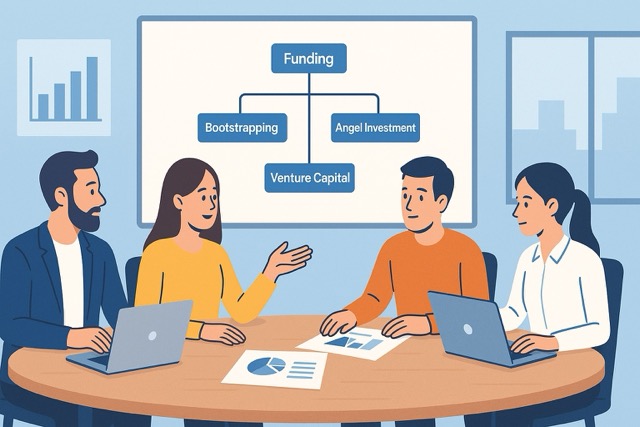
The main startup funding options Kenya founders may consider include founder capital, equity investment, bank debt, specialised financing facilities, development finance programmes and revenue-based finance. Each option should be assessed according to cost, repayment obligations, dilution and operational requirements.
A practical financing framework begins by separating capital into broad categories.
Equity Capital
The investor provides capital in exchange for ownership or an instrument that may later convert into ownership.
The investor’s return generally depends on the long-term value of the company.
Debt Capital
The company receives funds that must generally be repaid under agreed terms.
The lender does not normally receive ordinary ownership simply because it provided the loan.
Alternative or Structured Capital
Some facilities combine characteristics that do not fit neatly into traditional debt or equity categories.
Examples may include:
- Revenue-based finance
- Convertible instruments
- Blended finance
- Sector-specific facilities
- Development finance programmes
- Asset finance
The key is understanding the economic substance of the funding.
Founders should avoid selecting capital solely because it appears easier to obtain.
The cheapest money today may become the most expensive money later if the terms restrict future growth.
Debt or Equity: What Is the Fundamental Difference?
Debt provides capital that generally requires repayment, while equity provides capital in exchange for ownership and participation in future business value. The central trade-off is usually repayment pressure versus ownership dilution.
Consider a startup raising KSh 20 million.
The company could potentially raise the money through equity.
The investor receives a percentage of the company.
Alternatively, the company may obtain debt.
The founders retain ownership but accept an obligation to repay the financing.
Neither option is automatically better.
The decision depends on whether the business can support repayment and whether the founders are comfortable giving up ownership.
| Factor | Debt | Equity |
|---|---|---|
| Repayment | Usually required | No scheduled repayment in the same way |
| Ownership dilution | Generally no | Yes |
| Interest cost | Often applicable | No conventional interest |
| Cash flow pressure | Can be significant | Usually lower in early stages |
| Investor/lender rights | Contractual lender rights | Ownership and governance rights may apply |
| Security | May be required | Usually not traditional loan security |
| Upside sharing | Generally limited to financing return | Investor participates in company value |
| Suitable for | Predictable cash flows | High-growth and uncertain businesses |
This comparison is useful, but founders should go further.
A financing decision should also consider:
- Currency risk
- Interest-rate exposure
- Covenants
- Personal guarantees
- Security over company assets
- Investor board rights
- Future dilution
- Reporting requirements
- Exit expectations
When Is Equity Funding the Better Option?
Equity may be more suitable when a startup is still developing its business model, has uncertain cash flows or needs capital for growth activities that may not generate immediate repayment capacity. The trade-off is dilution and increased investor involvement.
Equity can be particularly relevant where a company needs to invest in:
- Product development
- Technology
- Market expansion
- Customer acquisition
- Team growth
- Intellectual property
- New business models
These activities may not immediately generate enough cash to service debt.
An early-stage company may therefore find conventional debt difficult.
Even where debt is available, repayment obligations can place significant pressure on cash flow.
An equity investor may accept greater uncertainty because the investor is seeking a return from future business growth.
However, founders should not think of equity as free money.
The cost is ownership.
Suppose a founder owns 100% of a company and sells 25% for KSh 20 million.
The company has no conventional loan repayment obligation.
However, the founder has permanently changed the ownership structure unless later transactions change that position.
If the company becomes significantly more valuable, the economic value of the ownership sold may be substantial.
That is why equity fundraising should be connected to a proper cap table cleanup process before new shares or convertible instruments are issued.
When Is Bank Debt Suitable for a Kenyan Startup?
Bank debt is generally more suitable where the business has predictable cash flows, a credible repayment capacity and assets or other support acceptable to the lender. Founders should assess total repayment obligations rather than focusing only on the loan amount.
Bank debt can support many different business needs.
Examples include:
- Working capital
- Equipment purchases
- Inventory
- Property improvements
- Expansion
- Trade finance
A lender will generally focus on the company’s ability to repay.
The analysis may consider:
- Historical revenue
- Profitability
- Cash flow
- Existing debt
- Assets
- Security
- Management capability
- Industry risk
For an early-stage startup with limited revenue, these requirements can be difficult.
For a more established SME, however, bank debt may allow growth without immediate equity dilution.
Founders Should Ask
Before accepting a bank facility, management should understand:
- What is the total interest cost?
- What fees apply?
- Is security required?
- Are personal guarantees required?
- What happens if revenue falls?
- Are there financial covenants?
- Can the lender demand early repayment?
- Does the facility create foreign-currency exposure?
- How will repayments affect working capital?
The ability to obtain debt should not automatically determine whether the business should take it.
The company must be able to carry it.
How Do HEVA and Sector-Specific Financing Facilities Fit Into Startup Funding?
Specialised sector financing facilities can provide funding structures designed around the needs of particular industries, but eligibility requirements and funding terms must be assessed carefully. Founders should compare the strategic fit of the facility with the business’s actual capital requirements.
Not every Kenyan business fits the traditional venture-capital model.
Some businesses operate in sectors where growth may be commercially attractive but does not match the investment profile sought by conventional venture investors.
Specialised funds and sector-focused financing programmes can therefore become relevant.
HEVA is commonly associated with financing and investment activity supporting the creative and cultural economy.
For businesses operating in relevant sectors, specialised capital can potentially provide alternatives to conventional commercial lending.
However, founders should evaluate any facility carefully.
Important questions include:
- Who is eligible?
- What business sectors qualify?
- Is the funding debt, equity or another structure?
- What reporting is required?
- What repayment terms apply?
- Is matching capital required?
- Are there restrictions on how funds can be used?
- Does the facility require specific impact outcomes?
A sector-specific facility should not be selected simply because it offers favourable branding or development support.
The business should still build a full financing model.
The company must understand the actual economic cost and contractual obligations.
Specialised capital can be highly valuable, but it should still fit into a coherent capital strategy.
What Are DFI Facilities and How Can They Support Kenyan Businesses?
Development finance institution facilities can support businesses and sectors where commercial capital alone may be insufficient or unsuitable. However, DFI-backed financing can involve specific eligibility, reporting, governance and impact requirements.
Development finance institutions, often referred to as DFIs, play an important role in financing economic development and private-sector growth.
DFI-supported capital may reach businesses through:
- Direct investment
- Local financial institutions
- Fund managers
- Guarantees
- Blended finance programmes
- Sector-specific initiatives
For a founder, the important point is that DFI-linked capital does not always mean applying directly to a large international institution.
The financing may be available through an intermediary.
This can include:
- Banks
- Funds
- Investment vehicles
- Specialist finance institutions
The terms can vary significantly.
Some programmes may focus on:
- SMEs
- Women-led enterprises
- Climate investment
- Manufacturing
- Agriculture
- Financial inclusion
- Employment creation
- Export businesses
A business should therefore assess the specific programme rather than assuming that “DFI funding” is one standard financing product.
What Is Revenue-Based Finance?
Revenue-based finance generally links repayment to business revenue rather than requiring fixed conventional instalments in the same way as a standard term loan. It can reduce some fixed repayment pressure, but the overall cost and contractual terms still require careful analysis.
Revenue-based finance has attracted attention as an alternative between traditional debt and equity.
In a simplified structure, the financier provides capital and receives an agreed percentage of future revenue until a specified repayment amount is reached.
For example:
- Capital received: KSh 10 million
- Revenue share: 8% of monthly revenue
- Total repayment obligation: Defined contractual amount
The exact structure varies.
The attraction for some businesses is flexibility.
If revenue falls, the payment may also fall, depending on the agreement.
If revenue grows, repayment may happen more quickly.
However, founders should not assume that revenue-based finance is automatically cheaper or easier than debt.
They should calculate:
- Total expected repayment
- Effective cost of capital
- Minimum payments
- Maximum repayment period
- Revenue reporting requirements
- Restrictions on future financing
Revenue-based finance may be more relevant to businesses with:
- Recurring revenue
- Predictable sales
- Strong gross margins
- Reliable customer demand
A business with highly volatile or minimal revenue may not be a suitable candidate.
How Does Revenue-Based Finance Compare With Equity?
Revenue-based finance may allow founders to raise growth capital without immediate ownership dilution, while equity does not normally create revenue repayment obligations. The better option depends heavily on revenue predictability and the company’s expected growth profile.
| Factor | Revenue-Based Finance | Equity |
|---|---|---|
| Ownership dilution | Usually no direct dilution | Yes |
| Repayment | Linked to agreed structure | No conventional repayment |
| Revenue impact | Payments may reduce cash available | No revenue share in the same way |
| Investor upside | Contractually defined | Linked to company value |
| Governance rights | Usually limited compared with equity | May include governance rights |
| Suitable for | Established recurring revenue | High-growth and earlier-stage businesses |
A rapidly growing company must consider an important question.
If revenue grows faster than expected, how quickly will the business repay the financier?
In some structures, fast growth can increase payments.
The company should model several scenarios.
Should Startups Combine Debt and Equity?
A combination of debt and equity can sometimes match different types of capital to different business needs. The objective should be to avoid using expensive equity for predictable assets or excessive debt for highly uncertain growth activities.
A startup does not always need to choose one source.
A company might use:
- Equity for product development
- Asset finance for equipment
- Working-capital facilities for inventory
- Revenue-based finance for marketing growth
This approach is sometimes referred to as a capital stack.
The principle is simple.
Different business needs may be financed differently.
For example, imagine a company needs KSh 50 million.
The requirement includes:
- KSh 20 million for product development
- KSh 15 million for equipment
- KSh 15 million for working capital
Using equity for the entire KSh 50 million may create unnecessary dilution.
Using debt for the entire KSh 50 million may create excessive repayment pressure.
A mixed structure could be considered.
| Business Need | Possible Capital Type |
|---|---|
| Product development | Equity |
| Equipment | Asset finance or debt |
| Inventory | Working capital facility |
| Market expansion | Equity or revenue-linked capital |
The appropriate structure depends on the business.
How Should Founders Calculate the True Cost of Debt?
The true cost of debt includes more than the stated interest rate. Founders should consider fees, security requirements, guarantees, repayment schedules and the operational consequences of restrictive financing terms.
A loan advertised with a particular interest rate may involve additional costs.
These can include:
- Arrangement fees
- Legal fees
- Insurance costs
- Security registration costs
- Penalty charges
- Commitment fees
There can also be non-cash costs.
For example, a personal guarantee can increase the founder’s personal exposure.
A restrictive covenant can limit the company’s ability to:
- Borrow more money
- Pay dividends
- Dispose of assets
- Raise additional capital
Management should therefore prepare a complete financing comparison.
How Should Founders Calculate the Cost of Equity?
The cost of equity is measured through ownership dilution and future value sharing rather than conventional interest payments. Founders should model dilution across multiple future financing rounds rather than considering only the current transaction.
Suppose a founder owns 80%.
The company raises a round and the founder’s ownership falls to 60%.
Later, another round reduces it to 45%.
An employee option pool creates further dilution.
The founder may still own a valuable stake.
However, ownership changes should be understood before signing.
Founders should model:
- Current ownership
- Proposed investment
- Option pool
- Convertible instruments
- Future financing scenarios
This analysis should be based on an accurate ownership structure.
Before fundraising, companies should ensure that their corporate records and ownership schedules are ready for investor review through proper company secretarial support.
How Do HEVA, DFI Facilities and Bank Debt Affect Financial Reporting?
Different financing structures can create different accounting and disclosure requirements. Finance teams should analyse the executed contractual terms rather than assuming that all capital received can be recorded in the same way.
A business receiving capital should determine how the transaction is reflected in its financial statements.
Depending on the terms, management may need to consider:
- Debt classification
- Equity classification
- Interest expense
- Fees
- Foreign-currency exposure
- Grant or incentive elements
- Disclosure requirements
- Covenants
This is particularly important where a company uses multiple financing instruments.
A clean accounting process should identify each facility separately.
The finance team should retain:
- Signed agreements
- Bank statements
- Facility letters
- Repayment schedules
- Security documents
- Correspondence relating to amendments
Good financial records make this easier.
Growing companies can strengthen financial reporting processes through professional Bookkeeping Services before financing complexity becomes difficult to manage.
What Will Investors and Lenders Want to See?
Both investors and lenders assess the company’s ability to manage capital, but their priorities differ. Founders should prepare financial and operational information before approaching any funding provider.
Equity Investors May Focus On
- Market opportunity
- Growth potential
- Management team
- Scalability
- Unit economics
- Ownership structure
- Exit potential
Lenders May Focus On
- Cash flow
- Debt-service capacity
- Security
- Existing liabilities
- Revenue stability
- Management reliability
Specialist and DFI-Linked Funders May Also Focus On
- Eligibility
- Development impact
- Sector fit
- Governance
- Environmental or social criteria
- Reporting capacity
The company should therefore prepare a financing data room that reflects the type of capital being sought.
For broader preparation, founders can review Investor Readiness Kenya and align financial, ownership and governance records before approaching funders.
Match the Capital to the Risk
The most sustainable financing strategy generally matches the risk profile of the capital source with the risk profile of the activity being funded. Highly uncertain investments may be poorly suited to rigid repayment obligations.
Consider two uses of capital.
Investment A: Experimental Product Development
The company is building a new product.
There is no guarantee of success.
Revenue may not begin for two years.
High fixed debt repayments may create unnecessary pressure.
Investment B: Purchase of Revenue-Generating Equipment
The company has contracts and predictable demand.
The equipment is expected to generate measurable cash flow.
A structured debt facility may be more appropriate.
This principle can help founders avoid a common mistake:
Using one type of funding for every business need.
Capital should be matched to purpose.
What Are the Risks of Taking Too Much Debt Too Early?
Excessive debt can create cash-flow pressure that limits a startup’s ability to invest, hire and survive periods of weaker revenue. Founders should stress-test repayment capacity before accepting a facility.
Debt repayments continue even when business conditions change.
A company should therefore model:
- Expected revenue
- Reduced revenue
- Delayed customer payments
- Increased costs
- Higher interest costs where applicable
Management should ask:
Can we continue meeting our obligations if revenue is 30% lower than expected?
The answer may influence the financing decision.
A funding facility should strengthen the company.
It should not create a repayment burden that threatens the underlying business.
What Are the Risks of Giving Away Too Much Equity Too Early?
Early equity decisions can have long-term consequences because dilution affects future ownership and control. Founders should raise sufficient capital for meaningful progress without treating equity as an unlimited source of inexpensive funding.
Common problems include:
- Raising too little and returning to investors immediately
- Raising too much before a clear valuation strategy
- Selling large ownership stakes early
- Ignoring future employee equity needs
- Failing to model future dilution
A founder should understand the difference between:
Cash raised
and
Ownership retained after multiple rounds.
This analysis should be part of fundraising planning.
How Should Kenyan Startups Prepare Before Choosing a Funding Option?
Before approaching investors or lenders, founders should prepare accurate financial information, ownership records and a clear explanation of how the capital will generate business value. Preparation improves the ability to compare offers and negotiate terms.
A practical preparation checklist includes:
Financial Readiness
- Current management accounts
- Cash-flow forecasts
- Historical financial statements
- Revenue analysis
- Expense analysis
- Debt schedule
Corporate Readiness
- Updated shareholder information
- Corporate records
- Material agreements
- Board records
Tax and Compliance Readiness
- Tax filings
- Relevant statutory records
- Compliance documentation
Funding Readiness
- Amount required
- Use of funds
- Milestones
- Expected outcomes
- Repayment model where applicable
- Dilution model where applicable
Businesses can also strengthen this preparation by working with professional CFO Advisory Services to develop financial models and decision-making processes around growth capital.
A Practical Framework for Comparing Startup Funding Options Kenya
Founders should compare funding options using a consistent framework covering cash-flow impact, ownership dilution, total cost, security and strategic restrictions. Comparing headline amounts alone can lead to poor financing decisions.
Use the following questions.
1. What Is the Capital For?
Is it funding:
- Growth?
- Equipment?
- Inventory?
- Product development?
- Expansion?
2. When Will It Generate Cash?
Immediate cash generation may support debt.
Long-term uncertain development may be better suited to equity.
3. Can the Business Repay the Capital?
Model realistic downside scenarios.
4. How Much Ownership Will Be Lost?
Model current and future dilution.
5. What Security Is Required?
Understand both company and personal exposure.
6. What Rights Does the Capital Provider Receive?
Review governance, reporting and contractual rights.
7. Does the Financing Restrict Future Funding?
Some agreements can affect future fundraising.
Final Checklist: Choosing Between Debt, Equity and Alternative Finance
The best startup funding option is the one that provides sufficient capital while preserving a sustainable balance between cash obligations, ownership and future flexibility. The financing decision should be modelled before terms are accepted.
Before signing, confirm:
-
The amount of capital required
-
The exact use of funds
-
Expected return on capital
-
Debt repayment capacity
-
Total interest and fees
-
Security requirements
-
Personal guarantee exposure
-
Equity dilution
-
Future dilution
-
Investor governance rights
-
Revenue-sharing obligations
-
Reporting requirements
-
Financial covenants
-
Impact on future fundraising
-
Accounting implications
-
Tax implications
Conclusion: The Best Capital Is Capital That Fits the Business
Startup funding options Kenya should be assessed according to business stage, cash flow, risk and growth strategy rather than popularity. Debt, equity, HEVA-type facilities, DFI-linked programmes and revenue-based finance can all be useful when matched to the right business need.
There is no universal answer to the debt-versus-equity question.
A company with predictable revenue may benefit from debt or revenue-linked financing.
A high-growth startup developing an unproven product may need equity capital that does not create immediate repayment pressure.
A business operating in a specialised sector may find that sector-focused or development-linked facilities provide additional opportunities.
The key is preparation.
Before approaching any capital provider, founders should understand:
- How much capital they need
- Why they need it
- What the capital will achieve
- How much ownership they are willing to dilute
- How much repayment the business can support
- What restrictions they are willing to accept
The strongest financing strategy is not simply about raising the largest amount of money.
It is about building a capital structure that gives the business enough resources to grow without creating unnecessary financial or ownership pressure.
Adamjee Auditors supports Kenyan businesses with audit, tax, financial reporting and advisory services that help management make more informed financing decisions.
Gain Clarity and Confidence in Your Finances
Navigate the complexities of compliance, tax, and financial management with a trusted partner. Adamjee Auditors, a member of Santa Fe Associates International (SFAI), provides world-class audit, tax, and advisory services to help your business achieve its goals.
Schedule a consultation with our expert team in Nairobi or Mombasa to discuss your business needs.
Nairobi Office
1st Floor, Le’Mac Building, Church Road, off Waiyaki Way, Westlands
Phone: +254 717 908 241
Email: madamjee@adamjeeauditors.co.ke
Mombasa Office
Suite 401, Motorwalla Building, Jomo Kenyatta Road
Phone: +254 750 053 053
Email: info@adamjeeauditors.co.ke
To discuss your startup’s financial strategy, funding readiness and reporting requirements, schedule a consultation with Adamjee Auditors.