When a business owner decides to sell, the obvious question is often: How much will the buyer pay? A more important question can be: Who is the buyer, and what does that buyer want to do with the business?
The difference between a strategic buyer and a financial buyer can affect valuation, due diligence, transaction structure, management expectations, the future of the business and the seller’s role after completion.
A strategic buyer generally acquires a business because it fits an existing commercial strategy. The target may provide customers, products, technology, distribution, geographic expansion, manufacturing capacity, intellectual property or other capabilities that complement the buyer’s existing operations.
A financial buyer, such as a private equity investor, generally approaches an acquisition as an investment. The objective is typically to invest capital into a business, support its growth and eventually realise a return through a future exit or other liquidity event.
Neither category automatically produces a particular price or transaction outcome. The implications depend on the buyer, target business, industry, competitive process and transaction structure.
For a Kenyan seller, understanding strategic vs financial buyer differences before approaching the market can make the sale process more deliberate and help the owner prepare for the questions each type of buyer is likely to ask.
What Is a Strategic Buyer?
A strategic buyer is an existing business or corporate group that acquires another business because the target fits its commercial or operational strategy. Strategic buyers may seek revenue growth, market expansion, new capabilities, distribution, technology, customers or operating efficiencies.
For example, imagine a Kenyan manufacturer with an established distribution network in Nairobi, Mombasa and Kisumu.
A larger regional manufacturer may be interested in acquiring it because the target provides:
- established customers;
- distribution infrastructure;
- local market knowledge;
- production capacity;
- trained employees;
- supplier relationships;
- licences;
- or access to a particular market segment.
The strategic buyer may already have its own manufacturing facilities and management team.
It is interested in the target because combining the two businesses could create commercial opportunities that neither company would achieve independently.
Strategic buyers can include:
- competitors;
- suppliers;
- distributors;
- multinational companies;
- regional groups;
- companies entering Kenya;
- companies expanding into East Africa;
- or businesses seeking complementary products and services.
The key feature is strategic fit.
What Is a Financial Buyer?
A financial buyer acquires a business primarily as an investment and evaluates the target according to its ability to generate sustainable cash flows, grow in value and ultimately produce an acceptable investment return.
Private equity funds are a common example.
A financial buyer may invest in a profitable Kenyan company with:
- strong recurring revenue;
- experienced management;
- attractive margins;
- growth opportunities;
- reliable financial reporting;
- scalable operations;
- and potential for a future exit.
The financial buyer may not already operate a competing business.
Instead, it may provide capital, governance, strategic support and financial discipline while allowing existing management to continue operating the company.
Depending on the transaction, a financial investor may also acquire a majority or minority interest rather than buying 100% of the business.
The distinction therefore goes beyond the source of funding.
The buyer’s investment thesis can determine what it focuses on during valuation, due diligence and negotiations.
Strategic vs Financial Buyer: The Core Difference
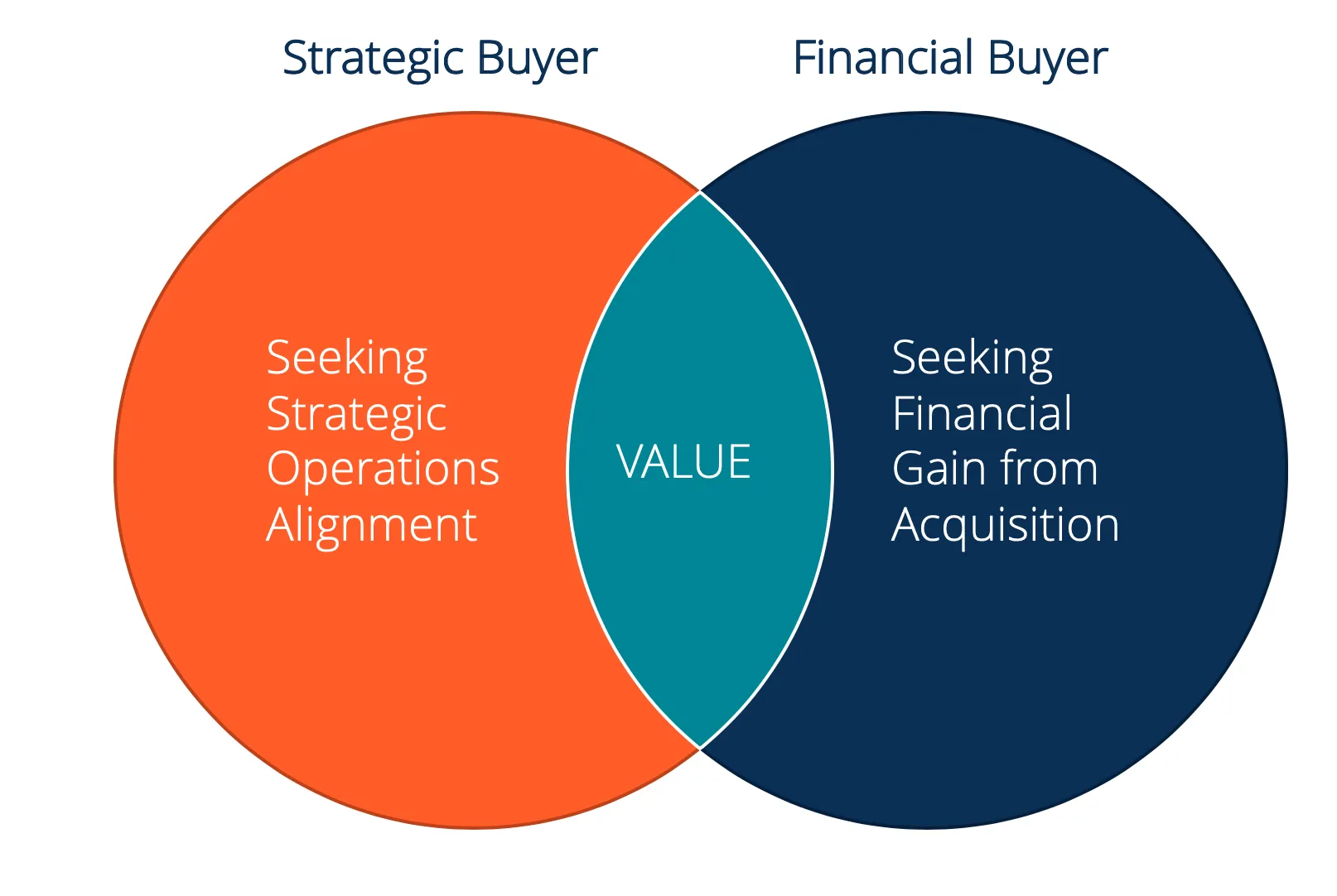
The main difference in strategic vs financial buyer transactions is the reason for acquiring the business. A strategic buyer is usually evaluating how the target fits into an existing business, while a financial buyer is evaluating the target as an investment capable of generating future returns.
| Issue | Strategic Buyer | Financial Buyer |
|---|---|---|
| Primary objective | Commercial or operational fit | Investment return |
| Typical buyer | Company or corporate group | Private equity or investment fund |
| Synergies | Often central to the thesis | Usually less dependent on operating synergies |
| Management | May integrate or replace functions | Often retains or strengthens management |
| Valuation focus | Standalone value plus strategic benefits | Sustainable earnings, cash flow and growth |
| Integration | Often more likely | Usually less operationally integrated |
| Future exit | May be less relevant to seller | Often central to investment thesis |
| Seller’s continuing role | Depends on integration strategy | Often possible where management is important |
| Due diligence | Commercial, operational and financial | Financial, commercial, legal, tax and investment-focused |
| Capital structure | May use corporate balance sheet and/or financing | Often involves acquisition financing and investor capital |
This table is a starting point, not a rulebook.
A strategic buyer can behave conservatively, while a financial buyer can pay substantial value for a high-growth company.
Why the Buyer Type Matters to the Seller
Strategic vs financial buyer considerations affect more than the headline purchase price. The buyer type can influence what happens to employees, management, facilities, brands, systems, customers and the seller’s involvement after completion.
Suppose two buyers make similar offers.
Buyer A is a competitor.
Buyer B is an investment fund.
The financial value offered may be similar, but the post-completion outcomes could be very different.
Buyer A might want to:
- combine operations;
- consolidate offices;
- eliminate duplicate functions;
- combine sales teams;
- move production;
- integrate accounting systems;
- or consolidate brands.
Buyer B might instead want to:
- expand the existing business;
- recruit additional management;
- invest in technology;
- enter new markets;
- acquire other companies;
- improve reporting;
- and prepare the business for a future sale.
Neither approach is inherently better.
The seller needs to understand which outcome is being negotiated alongside the price.
How a Strategic Buyer May Look at Your Business
A strategic buyer may value aspects of the target that do not appear fully in historical financial statements. Customers, distribution, geographic coverage, technology, capacity and market access can have strategic importance to an existing operator.
Imagine a Kenyan logistics company generating KSh 300 million in annual revenue.
On a standalone basis, a buyer may value the company according to its maintainable earnings and growth prospects.
But a regional logistics group may see additional value because the target has:
- routes in underserved locations;
- long-term customer contracts;
- a specialised fleet;
- a strong technology platform;
- a strategically located warehouse;
- or relationships with major institutional customers.
Those assets may complement the buyer’s existing network.
The strategic buyer’s internal business case may therefore differ from the seller’s standalone valuation analysis.
This does not mean the seller automatically receives the buyer’s entire synergy value.
The buyer will consider how much value the transaction creates and how much of that value it is prepared to transfer to the seller through the purchase price.
How a Financial Buyer May Look at Your Business
A financial buyer is usually more focused on sustainable earnings, cash generation, growth potential, management capability, downside protection and the eventual investment return.
A financial investor may ask:
- How predictable is revenue?
- How strong are gross margins?
- How much working capital does growth require?
- What is the quality of EBITDA?
- How much capital expenditure is required?
- How dependent is the business on one customer?
- Can the management team operate without the founder?
- How much debt can the business support?
- What growth opportunities are realistically available?
- What could the business be worth at a future exit?
This makes financial reporting particularly important.
If the accounts contain unexplained related-party expenses, personal costs, inconsistent revenue recognition or weak working-capital records, the investor may spend more time investigating the quality of earnings.
A seller preparing for this type of buyer should therefore consider a structured financial due diligence process before entering negotiations.
Strategic vs Financial Buyer and Valuation
Strategic vs financial buyer valuation differences often arise because each buyer may have a different economic rationale for owning the company. However, the seller should not assume that a strategic buyer will automatically pay more or that a financial buyer will automatically pay less.
A strategic buyer may see:
Standalone business value + potential commercial synergies
A financial buyer may see:
Standalone business value + achievable growth + operational improvements + future exit value
The actual offer depends on:
- competition between buyers;
- quality of the business;
- financing availability;
- market conditions;
- expected returns;
- transaction risk;
- management quality;
- growth prospects;
- and the seller’s negotiating position.
This is why a competitive sale process can be valuable.
If appropriate buyers are approached systematically, the seller can compare not just offers but also transaction structures and post-completion expectations.
For a deeper assessment of the underlying business value, sellers can review business valuation services in Kenya.
What Strategic Buyers May Pay For
Strategic buyers may place particular importance on commercial assets that strengthen their existing operations. These can include customer relationships, geographic reach, distribution, products, technology, production capacity and market access.
Consider a Kenyan food manufacturer that has developed a distribution network reaching hundreds of independent retailers.
A larger manufacturer may already have production capacity but lack an efficient route-to-market.
The target’s distribution network could therefore be strategically important.
Other examples include:
Geographic expansion
A regional company may acquire a Kenyan business to establish or strengthen its East African presence.
Product expansion
A company may acquire a complementary product line instead of developing the product internally.
Customer access
An established customer base may accelerate market entry.
Technology
A buyer may want software, systems or intellectual property that would take years to build internally.
Capacity
Manufacturing facilities, warehouses or equipment can provide faster expansion than building new infrastructure.
Talent
A specialised workforce can be valuable where certain skills are difficult to recruit.
The seller should identify these strategic attributes before approaching potential buyers.
What Financial Buyers May Pay For
Financial buyers tend to place substantial emphasis on predictable cash flows, growth, management depth, operational scalability and the potential to increase enterprise value over their investment period.
This can make certain businesses particularly interesting when they have:
- recurring revenue;
- strong customer retention;
- scalable operations;
- clear growth opportunities;
- professional management;
- defensible margins;
- reliable financial reporting;
- and a credible expansion plan.
Financial investors may also consider whether the business can make additional acquisitions.
For example, an investment platform may acquire one established Kenyan business and subsequently combine it with smaller businesses in the same sector.
This is sometimes described as a buy-and-build strategy.
The seller should therefore understand not only the buyer’s current offer but also the buyer’s broader investment thesis.
What Changes During Due Diligence?
Strategic vs financial buyer due diligence can overlap substantially, but the questions may be framed differently. Strategic buyers often investigate integration and commercial fit, while financial buyers focus heavily on earnings quality, cash generation, growth and investment returns.
Both buyer types may review:
- financial statements;
- tax records;
- bank accounts;
- contracts;
- employees;
- litigation;
- assets;
- intellectual property;
- licences;
- customers;
- suppliers;
- debt;
- working capital;
- and regulatory compliance.
However, the emphasis may differ.
Strategic buyer questions
A strategic buyer may ask:
- Can our sales team cross-sell these products?
- Can we combine the target’s operations with ours?
- Are customers transferable?
- Can we eliminate duplicate costs?
- Can we integrate the technology?
- Will customers accept the acquisition?
- Are there competition concerns?
Financial buyer questions
A financial buyer may ask:
- How reliable is EBITDA?
- What is the cash conversion rate?
- What is the required capital expenditure?
- What is the working-capital requirement?
- What are the realistic growth assumptions?
- How strong is management?
- What downside scenarios exist?
- What could the business be worth at exit?
The seller should prepare for both.
Management Expectations Can Be Very Different
The seller’s future role can depend significantly on whether the buyer intends to integrate the company or continue operating it as a standalone investment.
A strategic buyer may decide that the existing management structure duplicates its own.
For example, if the buyer already has:
- a CFO;
- HR department;
- procurement team;
- sales director;
- IT department;
- and finance systems,
it may consolidate some or all of those functions.
A financial buyer may instead decide that existing management is essential to delivering the investment plan.
That can lead to:
- management retention;
- employment agreements;
- incentive plans;
- performance targets;
- management equity;
- or earn-out arrangements.
The seller should therefore establish early whether they are selling:
the business and leaving, or
the business while remaining involved for a defined transition period.
That distinction can affect the structure of the transaction.
What Happens to Employees?
Employees can be affected differently depending on the buyer’s operating model. A strategic buyer may seek integration efficiencies, while a financial buyer may focus on strengthening the organisation for growth.
Neither outcome is automatic.
The seller should identify critical employees and determine:
- who is essential to operations;
- who has specialist knowledge;
- who owns key customer relationships;
- which employees are difficult to replace;
- and which positions may overlap with the buyer’s existing structure.
Employment matters should be considered during transaction planning rather than left entirely to post-completion discussions.
This is particularly important when the company’s value depends heavily on a small management team.
Strategic vs Financial Buyer and Founder Dependency
Founder dependency can become a major transaction issue when the business’s revenue, customer relationships or operational decisions depend heavily on one owner. Both strategic and financial buyers may discount or restructure an offer if they believe performance could deteriorate after the founder exits.
A seller should test the business before going to market.
Ask:
- Can customers be transferred to another relationship manager?
- Can management run the company without the founder?
- Are passwords and records institutionalised?
- Are supplier relationships documented?
- Can the founder take a 60-day absence without major disruption?
- Are important decisions delegated?
- Does the business have second-line leadership?
A business that can operate without its founder is generally easier to explain as a transferable commercial asset.
This is particularly relevant when preparing for sell-side advisory.
Transaction Structure May Change With the Buyer
Strategic vs financial buyer negotiations can produce different transaction structures because the buyer’s objectives and risk appetite may differ. Sellers should evaluate the entire consideration package rather than focusing only on the headline price.
Possible transaction terms include:
- cash at completion;
- deferred consideration;
- earn-outs;
- escrow;
- seller financing;
- rollover equity;
- retained minority shares;
- management incentives;
- and completion accounts adjustments.
A strategic buyer may prefer a clean acquisition followed by integration.
A financial buyer may be more open to the seller retaining a minority stake if the seller continues to participate in future growth.
Again, this depends on the particular buyer and transaction.
The seller should calculate the effective economic value of the entire offer.
For example:
Headline consideration
- retained equity value
- deferred consideration
- expected earn-out
− transaction costs
− taxes
− financing or other adjustments
= Expected economic outcome
An earn-out should not be valued as though it were guaranteed cash.
Rollover Equity Changes the Seller’s Position
When a financial buyer offers rollover equity, the seller may remain financially exposed to the future performance of the business. This can provide continuing participation in growth but also means the seller is not receiving a completely clean exit.
For example, a seller might:
- sell 80% of the company;
- retain 20%;
- continue as an executive or board member;
- and participate in a future exit.
This can align the seller with the investor’s growth strategy.
However, the seller should understand:
- how the retained shares are valued;
- shareholder rights;
- dilution;
- future funding;
- exit rights;
- governance;
- transfer restrictions;
- drag-along rights;
- tag-along rights;
- and how the future exit will be determined.
Rollover equity should therefore be assessed as a new investment, not simply as an extension of the original sale.
Strategic vs Financial Buyer and Negotiating Leverage
The strongest negotiating position often comes from understanding the buyer’s specific reasons for wanting the business. A seller who understands strategic value can negotiate more intelligently than a seller who focuses only on the company’s historical accounts.
For a strategic buyer, ask:
- What problem does our business solve?
- What capability are they acquiring?
- Which customers or markets matter most?
- What synergies do they expect?
- What would they have to spend to build the same capability themselves?
For a financial buyer, ask:
- What is their investment thesis?
- What growth assumptions support their valuation?
- What management structure do they expect?
- What financing will be used?
- What is their intended investment horizon?
- What would make the investment successful?
These questions do not guarantee a higher price.
They help the seller understand the economic rationale behind the offer.
Can a Strategic Buyer Create Competition Issues in Kenya?
A strategic acquisition can raise competition-law questions where the transaction changes control and affects market structure. In Kenya, the Competition Authority of Kenya regulates mergers and acquisitions under the Competition Act.
CAK defines a merger as an acquisition of shares, a business or other assets that results in a change of control of a business, part of a business or an asset of a business in Kenya. The Authority assesses whether transactions meet the applicable notification thresholds and examines their competitive and public-interest effects.
This can be particularly relevant when the buyer is:
- a direct competitor;
- a major supplier;
- a major distributor;
- or an existing market participant.
The seller should not assume that a transaction is exempt simply because the parties describe it as an acquisition.
CAK states that it can review transactions for mandatory notification and provides advisory opinions where parties are uncertain about the applicable requirements.
Where notification is required, transaction planning should account for the regulatory process.
CAK currently states that it aims to determine a merger proposal within 60 days after receiving complete information, subject to circumstances such as requests for further information or a hearing.
Do Financial Buyers Face the Same Regulatory Issues?
Financial buyers can also be subject to Kenyan merger-control requirements where their investment results in the acquisition of control. The fact that an investor is a financial buyer does not automatically remove a transaction from competition-law analysis.
CAK’s merger guidelines consider acquisitions of shares, businesses and assets where control is acquired.
The Authority’s guidelines also recognise situations involving private-equity ownership and indirect control when assessing who is acquiring control.
The relevant analysis therefore depends on:
- the structure of the acquisition;
- control rights;
- ownership;
- the buyer’s existing interests;
- the target’s market;
- turnover or asset thresholds;
- and other applicable regulatory requirements.
The parties should establish the regulatory position before committing to a transaction timetable.
Which Buyer Will Ask More Questions?
There is no universal rule that strategic buyers or financial buyers conduct more extensive due diligence. Both can be highly detailed, but the focus of their questions may differ.
A strategic buyer may investigate operational compatibility in depth.
A financial buyer may spend significant time testing the quality of earnings and the assumptions supporting future growth.
For a seller, the practical lesson is simple:
Prepare as though both types of buyer will scrutinise everything.
That means having:
- reconciled accounts;
- tax records;
- contracts;
- asset registers;
- employee records;
- customer information;
- supplier information;
- licences;
- litigation records;
- forecasts;
- and corporate documents
ready before due diligence begins.
How to Prepare for Both Buyer Types
A seller does not need to choose between strategic and financial buyers at the beginning of the process. Preparing the business properly can allow the seller to approach different buyer categories and compare their proposals.
Step 1: Establish standalone value
Determine what the business is worth independently of any buyer-specific synergies.
Step 2: Identify strategic value
Map the characteristics that could be particularly valuable to competitors, regional groups or complementary businesses.
Step 3: Strengthen financial reporting
Make sure revenue, margins, working capital, debt and cash flow are clearly supported.
Step 4: Reduce founder dependency
Build management depth and document critical processes.
Step 5: Resolve ownership issues
Clean up shareholder records, related-party balances and corporate documentation.
Step 6: Prepare a data room
Organise financial, legal, tax, commercial and operational information.
Step 7: Develop the transaction strategy
Decide whether the objective is:
- a full exit;
- partial exit;
- retained equity;
- strategic integration;
- or a transition arrangement.
Step 8: Assess buyers individually
Do not treat all strategic buyers or all financial buyers as identical.
The specific buyer’s objectives matter more than the category alone.
Should a Seller Approach Both Strategic and Financial Buyers?
Approaching both strategic and financial buyers can broaden the pool of potential counterparties, but the appropriate process depends on the business, confidentiality considerations, market and seller objectives.
A strategic buyer may see value that a financial buyer does not.
A financial buyer may offer a structure that gives the founder continued participation.
Another buyer may provide a cleaner exit.
A structured sale process can therefore compare:
- price;
- cash at completion;
- deferred consideration;
- earn-outs;
- retained equity;
- management requirements;
- warranties;
- indemnities;
- regulatory conditions;
- and post-completion obligations.
The comparison should be based on the full economic and practical consequences of each offer.
What Should a Seller Ask Before Accepting an Offer?
The seller should evaluate the buyer’s identity, transaction structure and post-completion intentions alongside the headline price. A financially attractive offer may have very different practical consequences from another offer with similar consideration.
Before signing, ask:
About the buyer
- Who ultimately controls the buyer?
- What is the buyer’s acquisition strategy?
- Does the buyer already operate in the same market?
- Has the buyer completed similar transactions?
About the transaction
- Is this a share sale or asset sale?
- How much is paid at completion?
- Is there deferred consideration?
- Is there an earn-out?
- Is seller financing involved?
- Is rollover equity required?
About management
- Will the founder remain?
- For how long?
- What responsibilities will continue?
- Will existing managers be retained?
About the business
- Will the brand continue?
- Will operations be integrated?
- Will locations remain open?
- What happens to employees?
- What happens to major customer relationships?
About risk
- What warranties are required?
- What indemnities are requested?
- What liability caps apply?
- How long do claims survive?
- What escrow or retention applies?
A seller should understand these issues before treating one offer as economically superior to another.
The Seller’s Position Changes After Signing
The transaction does not end with the purchase price being agreed. The seller’s continuing obligations may include warranties, indemnities, restrictive covenants, transition services, earn-out targets or employment commitments.
This is why the purchase agreement deserves as much attention as the headline valuation.
For example, a seller may receive a high headline price but retain significant exposure through:
- a large escrow;
- broad indemnities;
- a long warranty period;
- aggressive earn-out conditions;
- or extensive post-completion obligations.
Another offer could have a slightly different headline price but a materially different risk profile.
The seller should therefore evaluate the net value and risk of the entire transaction, not simply the initial number.
Businesses considering a transaction can also review guidance on how to sell a business in Kenya before entering a formal process.
Strategic vs Financial Buyer: Questions Sellers Often Ask
Is a strategic buyer always willing to pay more?
No. A strategic buyer may identify synergies, but it does not automatically mean the buyer will pay more. The offer depends on the buyer’s strategy, expected value creation, competition and transaction risks.
Is a financial buyer only interested in profit?
Financial buyers generally evaluate investment returns, but their analysis can include management quality, market position, growth, operational improvements, cash generation and strategic opportunities.
Will a strategic buyer replace my management team?
Not necessarily. Some strategic buyers integrate management functions, while others retain existing leadership where it is commercially valuable. The outcome depends on the buyer’s integration strategy.
Will a private equity buyer let me remain involved?
Potentially. Financial investors may retain existing management when the team is important to the investment thesis. The seller’s continuing role should be documented clearly.
Can I retain shares after selling to a financial buyer?
Potentially. Some transactions allow sellers or management to roll part of their proceeds into the acquiring structure. The economic and governance terms need careful review.
Does a strategic acquisition require CAK approval?
Not automatically. The applicable merger-control requirements depend on whether the transaction constitutes a merger, whether control changes and whether the relevant notification thresholds and other requirements are met. CAK provides merger guidance and advisory opinions for parties that need clarification.
What matters more: the buyer or the price?
Both matter, but they answer different questions. The price determines immediate economic value, while the buyer’s objectives can determine what happens to the company, employees, management and the seller after completion.
Final Takeaway
Strategic vs financial buyer is not simply a distinction between two types of investors. It is a distinction between different reasons for acquiring a business, and those reasons can influence valuation, due diligence, transaction structure and the seller’s future role.
A strategic buyer may be interested because the business strengthens an existing operation.
A financial buyer may be interested because the business presents an attractive investment opportunity with potential for growth and a future exit.
For the seller, the important task is to understand the specific buyer rather than rely on assumptions about the category.
Before entering negotiations, establish the standalone value of the business, identify potential strategic value, strengthen financial records, prepare for due diligence, clarify the seller’s preferred exit and understand the buyer’s post-completion plans.
Most importantly, compare the whole transaction rather than the headline price alone.
The right analysis asks:
What am I receiving, what am I giving up, what risks remain after completion, and what happens to the business once I am no longer in control?
That is the practical significance of understanding strategic vs financial buyer dynamics before selling a Kenyan business.
Gain Clarity and Confidence in Your Finances
Navigate the complexities of compliance, tax, and financial management with a trusted partner. Adamjee Auditors, a member of Santa Fe Associates International (SFAI), provides world-class audit, tax, and advisory services to help your business achieve its goals.
Schedule a consultation with our expert team in Nairobi or Mombasa to discuss your business needs.
Nairobi Office
Park View Heights, Mombasa Road, OR Mbandu Complex, Langata Road
+254 717 908 241
madamjee@adamjeeauditors.co.ke
Mombasa Office
Suite 401, Motorwalla Building, Jomo Kenyatta Road
+254 750 053 053
info@adamjeeauditors.co.ke
Adamjee Auditors