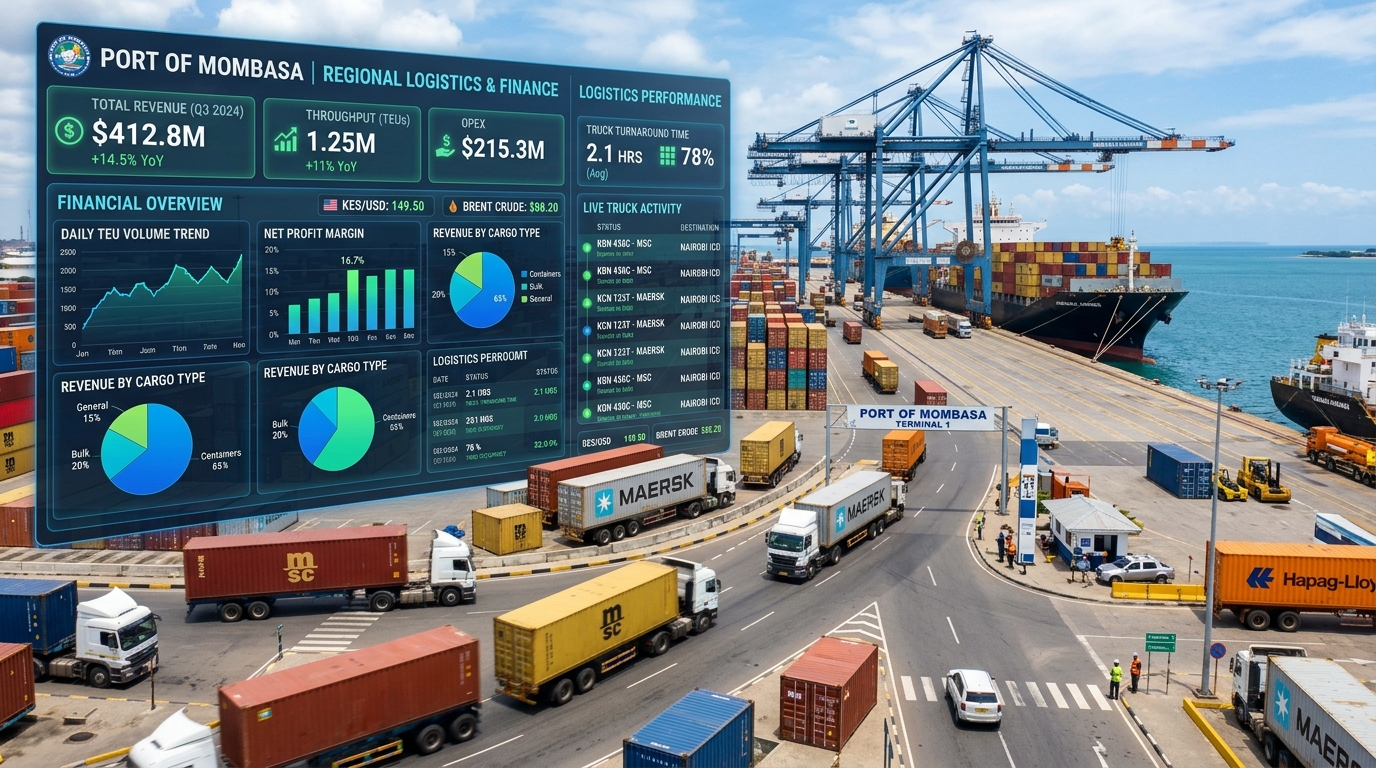
- Financial ratios give logistics firms in Mombasa an objective measure of financial health beyond raw revenue figures.
- The transport and freight sector is cash- and asset-intensive, so tracking liquidity and leverage ratios is especially important.
- Ratios help logistics businesses spot problems early, support lending decisions and improve operational efficiency.
- Consistent ratio analysis strengthens audit readiness and stakeholder confidence.
- Professional advisory support can help logistics companies interpret ratios and act on the insights.
Monitoring the right Mombasa Logistics Financial Ratios helps transport, freight forwarding, warehousing, and logistics businesses improve profitability, strengthen cash flow, manage debt effectively, and make informed financial decisions.
Mombasa is East Africa’s leading logistics hub, connecting Kenya with regional and international markets through the Port of Mombasa. Logistics companies operating in the city face significant operational costs, including fuel, fleet maintenance, labour, insurance, customs charges, and warehousing expenses. Managing these costs while maintaining profitability requires more than simply increasing revenue—it requires understanding the numbers behind the business.
The most successful Mombasa Logistics Financial Ratios businesses rely on financial ratios to monitor performance, identify risks, and support strategic decision-making. These ratios provide valuable insights into liquidity, operational efficiency, profitability, and financial stability.
At Adamjee Auditors, we help transport and logistics companies make sense of their financial information through our Audit & Assurance Services, Bookkeeping Services, Tax Compliance Services, and CFO Advisory Services. By combining accurate financial reporting with practical advisory services, we help businesses improve financial performance and achieve sustainable growth.
Whether you operate a trucking company, freight forwarding business, clearing and forwarding agency, warehouse, or distribution company, understanding these financial ratios can help you make better business decisions.
Why Mombasa Logistics Financial Ratios Matter
Financial ratios convert accounting data into meaningful performance indicators that enable management to evaluate the financial health of a business.
For logistics companies, these ratios help to:
- Monitor cash flow.
- Measure profitability.
- Improve operational efficiency.
- Manage debt responsibly.
- Evaluate business growth.
- Support financing applications.
- Strengthen investor confidence.
- Improve budgeting and forecasting.
Accurate financial ratios depend on reliable accounting records. Our Bookkeeping Services help businesses maintain accurate financial information, making financial analysis more reliable and effective.
1. Current Mombasa Logistics Financial Ratios– Measuring Liquidity
The Current Ratio measures whether a business has sufficient current assets to meet its short-term financial obligations.
Formula
Current Assets ÷ Current Liabilities
A healthy Current Ratio helps logistics companies meet day-to-day expenses such as fuel purchases, driver salaries, warehouse costs, insurance premiums, and vehicle maintenance without placing unnecessary pressure on cash flow.
Businesses can improve liquidity by reducing overdue receivables, negotiating supplier payment terms, and improving cash flow forecasting through our CFO Advisory Services.
2. Gross Profit Margin – Measuring Operational Profitability
Gross Profit Margin measures how efficiently a logistics company delivers its services after deducting direct operating costs.
These costs often include:
- Fuel
- Driver wages
- Vehicle maintenance
- Port handling charges
- Freight subcontracting
- Warehouse operating expenses
Declining margins may indicate rising fuel costs, inefficient fleet utilisation, or underpriced customer contracts.
Regular financial reviews together with our Audit & Assurance Services help management identify operational inefficiencies before they affect long-term profitability.
3. Accounts Receivable Turnover – Improving Cash Collections
Many logistics businesses provide credit terms to corporate clients. Slow collections can significantly affect working capital, even when revenues continue to grow.
The Accounts Receivable Turnover Ratio measures how efficiently outstanding invoices are collected.
A higher ratio generally indicates:
- Faster customer payments.
- Improved liquidity.
- Reduced borrowing requirements.
- Better credit management.
Businesses should regularly review outstanding customer balances and strengthen credit control procedures to improve collections.
4. Debt-to-Equity Ratio – Managing Financial Risk
Fleet expansion, warehouse development, and equipment purchases often require external financing.
The Debt-to-Equity Ratio measures the relationship between borrowed funds and shareholders’ equity.
A balanced capital structure enables Mombasa Logistics Financial Ratios companies to:
- Finance expansion responsibly.
- Reduce financial risk.
- Improve investor confidence.
- Enhance borrowing capacity.
Our Tax Compliance Services also help businesses understand the tax implications of financing decisions while ensuring compliance with Kenyan tax regulations.
5. Return on Assets (ROA) – Measuring Asset Efficiency
Logistics companies invest heavily in vehicles, warehouses, equipment, and technology.
Return on Assets measures how effectively these assets generate profits.
Higher ROA generally indicates:
- Better fleet utilisation.
- Improved warehouse productivity.
- Efficient capital investment.
- Strong operational performance.
Management should review ROA alongside profitability and liquidity indicators for a comprehensive understanding of business performance.
Best Practices for Monitoring Mombasa Logistics Financial Ratios
To maximise the value of Mombasa Logistics Financial Ratios, businesses should:
- Prepare monthly financial statements.
- Monitor cash flow regularly.
- Compare ratios against previous periods.
- Benchmark performance against industry standards.
- Review customer payment trends.
- Analyse operating costs monthly.
- Maintain accurate accounting records.
- Seek professional financial advice before making major investment decisions.
Our Company Secretarial Services and Offshore Accounting Services also support businesses with governance, compliance, and financial reporting requirements.
Frequently Asked Questions About Mombasa Logistics Financial Ratios
Which financial ratio is most important?
There is no single most important ratio. Businesses should monitor liquidity, profitability, debt management, and efficiency together for a complete financial picture.
How often should financial ratios be reviewed?
Monthly reviews are recommended to identify trends early and make informed business decisions.
Can financial ratios help secure financing?
Yes. Banks and investors frequently analyse financial ratios when evaluating loan applications or investment opportunities.
Why is bookkeeping important?
Accurate bookkeeping ensures financial ratios are based on reliable financial information. Our Bookkeeping Services help businesses maintain complete and accurate records.
Where can I learn more about Kenyan financial compliance?
Visit our Articles, attend our Free Webinars, or use our Compliance Checker and PAYE Calculator for practical compliance support.
Get Expert Financial & Audit Guidance Today on Mombasa Logistics Financial Ratios
Navigating Kenya’s financial and regulatory landscape can be complex. Let Adamjee Auditors provide the expertise and support your logistics business needs to remain compliant, improve profitability, and achieve long-term success.
Contact us today through our Contact Page to schedule a consultation with our audit, tax, and advisory specialists.
Nairobi Office
1st Floor, Le’Mac Building, Church Road, off Waiyaki Way, Westlands, Nairobi
+254 750 053 053
madamjee@adamjeeauditors.co.ke
Mombasa Office
Suite 401, Motorwalla Building, Jomo Kenyatta Road, Mombasa
+254 717 908 241
info@adamjeeauditors.co.ke
Serving Businesses Across Kenya
Nairobi • Mombasa • Kisumu • Nakuru • Eldoret • Thika • Malindi • Kitale • Garissa • Kakamega • Nyeri • Meru • Machakos • Naivasha • Kericho • Nanyuki • Embu • Narok • Kilifi • Diani