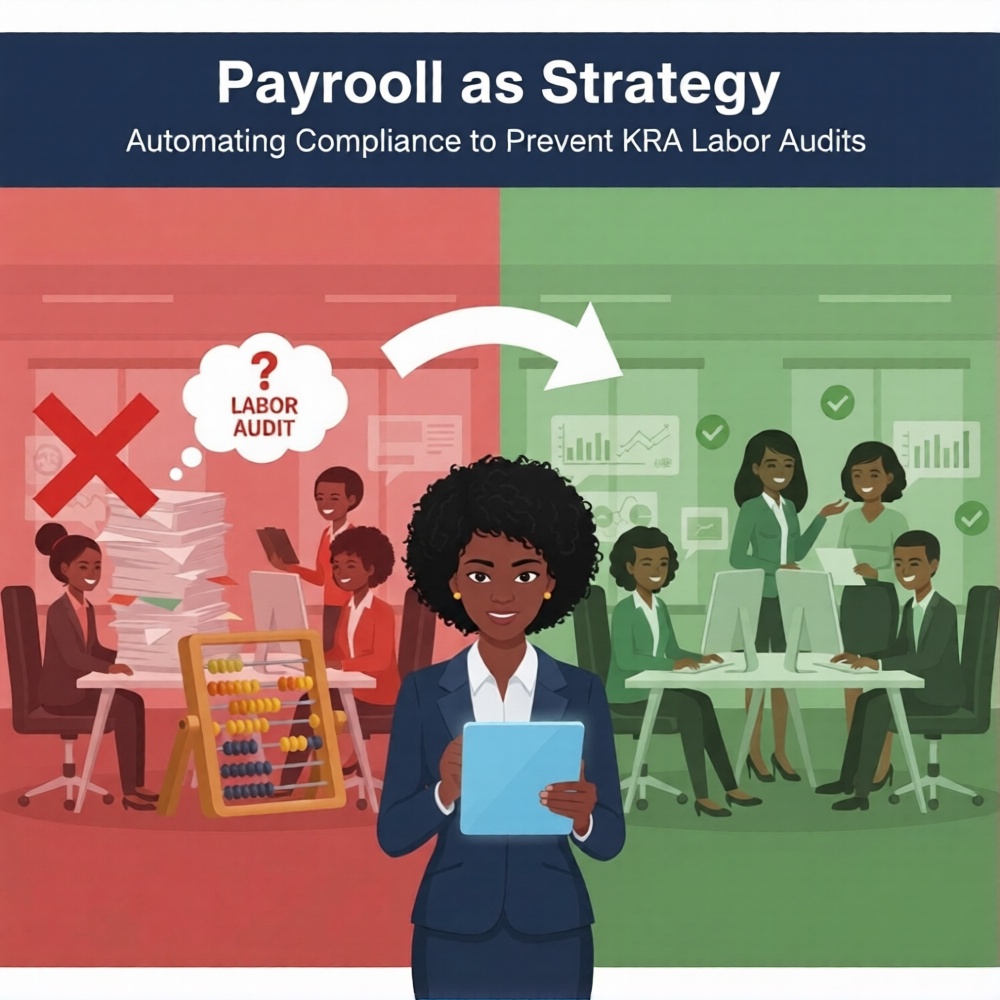
- Payroll sits at the intersection of PAYE, NSSF, SHIF, the Affordable Housing Levy, and withholding tax, and KRA now cross-checks payroll data against employee filings, company returns, statutory remittances, and bank records.
- The Finance Act 2025 expanded employer liability for incorrect deductions, raised penalties for late remittances, and enhanced audit powers, requiring detailed records like contracts, allowance breakdowns, and reconciliation schedules.
- Common audit triggers include ghost employees, employee-contractor misclassification, informal cash salary payments, incorrect allowance treatment, and delayed statutory remittances.
- Payroll automation reduces audit risk through real-time statutory calculations, automatic tax-table and levy updates, integrated reporting, and audit-ready documentation.
- Under the Companies Act, directors are responsible for payroll compliance, and weak governance exposes them to personal liability; accurate automated records also support KRA Automated Payment Plan (APP) eligibility for arrears.
Payroll Compliance Automation,is often viewed as a routine administrative function—calculating salaries, processing deductions, and ensuring employees are paid on time. However, in Kenya’s 2026 regulatory environment, payroll has evolved into a high-risk compliance area that directly affects tax exposure, corporate governance, and audit readiness.
With increased data sharing between regulatory bodies, automated compliance verification, and expanded enforcement under the Finance Act 2025, payroll errors can trigger costly KRA labor audits, statutory penalties, and reputational damage.
Forward-thinking organizations are now transforming payroll from a transactional function into a strategic compliance system powered by automation, internal controls, and regulatory alignment.
At Adamjee Auditors, a member of SFAI Global, we support Kenyan businesses in designing payroll systems that minimize audit risk while improving operational efficiency and workforce transparency.
Why Payroll Is a Major KRA Audit Trigger in 2026
Payroll sits at the intersection of multiple statutory obligations, including:
-
Pay As You Earn (PAYE)
-
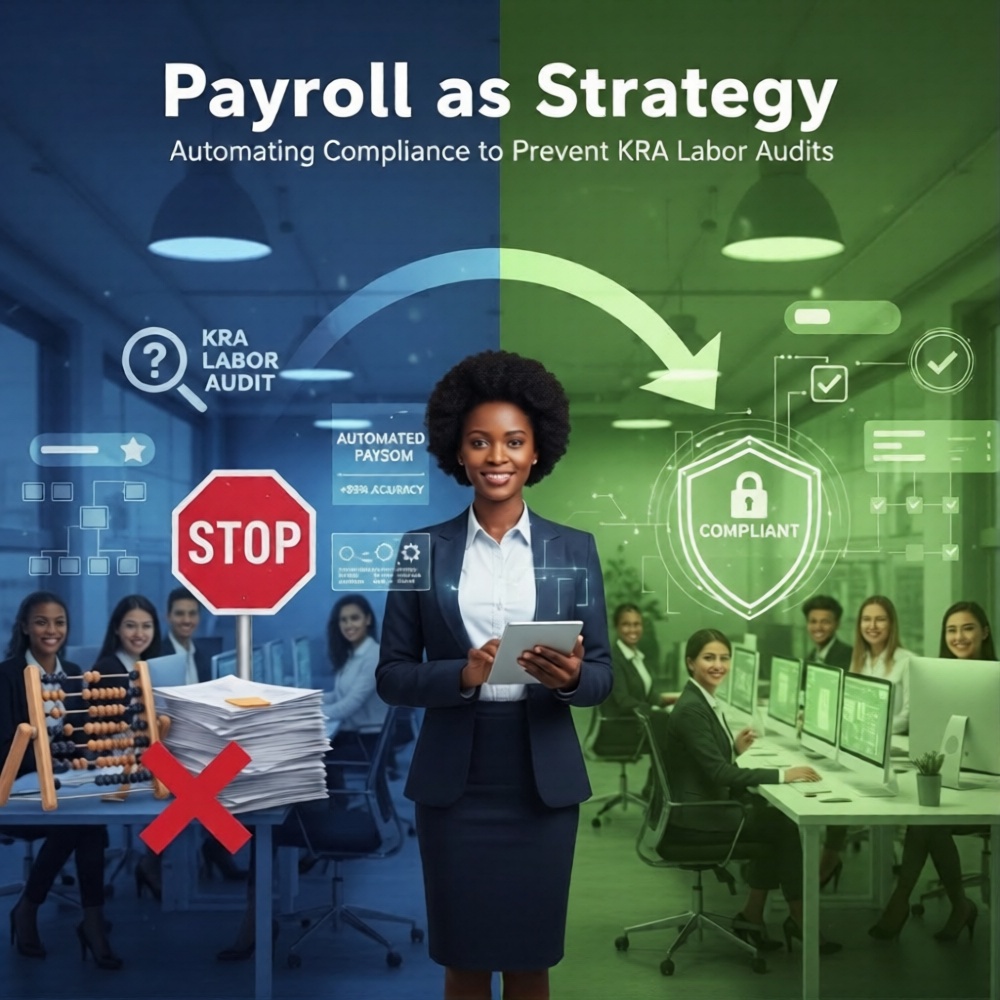
Automating payroll in 2026 turns compliance from a risk into a strategic advantage—keeping your business audit-ready and KRA-proof. National Social Security Fund (NSSF)
-
Social Health Insurance Fund (SHIF)
-
Affordable Housing Levy
-
Withholding tax obligations (where applicable)
The Kenya Revenue Authority has significantly expanded automated cross-checking systems that compare payroll data against:
-
Individual employee tax filings
-
Company income tax returns
-
Statutory remittance submissions
-
Bank payment records
Any inconsistency can trigger audit flags.
In many cases, payroll discrepancies reveal broader governance and financial control weaknesses, making payroll one of the first areas regulators review during tax investigations.
Our Payroll Services help businesses implement compliant and audit-ready payroll frameworks.
The Impact of the Finance Act 2025 on Payroll Compliance
The Finance Act 2025 strengthened payroll enforcement through enhanced digital verification and increased penalties for non-compliance.
Key regulatory developments include:
-
Expanded employer liability for incorrect employee tax deductions
-
Increased penalties for late statutory remittances
-
Improved integration between payroll reporting and iTax records
-
Enhanced audit powers for employment tax investigations
Employers are now required to maintain detailed payroll records, including:
-
Employee contracts
-
Tax relief documentation
-
Allowance breakdowns
-
Statutory deduction calculations
-
Payroll reconciliation schedules
Failure to maintain proper payroll documentation can result in reassessed tax liabilities and employer penalties.
For integrated tax compliance reviews, businesses should consider our Tax Compliance and Advisory Services.
How eTIMS Is Influencing Payroll Compliance
Although eTIMS primarily governs sales and expense invoicing, it indirectly affects payroll through expense validation and audit trail verification.
In 2026, payroll-related expenses such as:
-
Staff allowances
-
Reimbursed expenses
-
Contractor payments
-
Staff benefit costs
must align with eTIMS-supported documentation where applicable.
For example:
-
Staff expense reimbursements without valid eTIMS invoices risk disallowance.
-
Contractor payments classified incorrectly as payroll may trigger withholding tax or PAYE disputes.
Payroll must therefore integrate with accounting and procurement systems to ensure full expense traceability.
Our Bookkeeping Services help businesses align payroll with accounting records and tax documentation.
Common Payroll Compliance Failures That Trigger Audits
1. Ghost Employees of Payroll Compliance Automation
Payroll systems without automated employee verification risk paying non-existent staff, which often signals fraud or weak internal controls.
2. Misclassification of Employees and Contractors
Improper classification can result in unpaid PAYE liabilities or incorrect withholding tax treatment.
3. Informal Salary Payments of Payroll Compliance Automation
Cash payments outside payroll systems create audit exposure and documentation gaps.
4. Incorrect Allowance Treatment
Housing, transport, and bonus allowances require correct tax classification under Kenyan payroll regulations.
5. Delayed Statutory Remittances of Payroll Compliance Automation
Late PAYE or statutory deduction payments attract penalties and interest charges.
These issues frequently arise in manual payroll systems or decentralized HR and finance functions.
How Payroll Automation Reduces Audit Risk
Payroll automation introduces standardized compliance workflows and eliminates human error.
Automated Payroll Systems Provide:
-
Real-time statutory deduction calculations
-
Integrated tax table updates
-
Automated payslip generation
-
Direct integration with accounting systems
-
Audit-ready payroll reporting
Automation ensures statutory changes—such as SHIF updates or housing levy adjustments—are applied consistently.
| Payroll Function | Manual Processing | Automated Processing |
|---|---|---|
| Tax Calculations | Error-prone | System-controlled |
| Compliance Updates | Delayed | Automatic |
| Payroll Reporting | Fragmented | Integrated |
| Audit Documentation | Incomplete | Standardized |
| Employee Records | Decentralized | Centralized |
Automation improves both compliance accuracy and operational efficiency.
Payroll Governance and Director Responsibility
Under the Kenyan Companies Act, directors are responsible for ensuring statutory compliance, including payroll obligations.
During audits or due diligence reviews, regulators and investors evaluate:
-
Payroll policy documentation
-
Segregation of payroll duties
-
Internal payroll approval controls
-
Statutory filing history
-
Employee contract compliance
Weak payroll governance exposes directors to personal liability and reputational risk.
Our Audit and Assurance Services provide independent payroll control reviews to strengthen governance frameworks.
The KRA Automated Payment Plan (APP) and Payroll Arrears
In 2026, the KRA Automated Payment Plan (APP) provides structured settlement options for employers with payroll tax arrears.
The APP allows:
-
Negotiated repayment schedules
-
Improved cash flow management
-
Reduced enforcement pressure
However, eligibility depends on accurate payroll records and complete statutory disclosures. Businesses with incomplete payroll documentation may face difficulty qualifying for relief.
Automation ensures payroll records remain complete and audit-ready, supporting APP eligibility when necessary.
Payroll Compliance and Investor Due Diligence
Payroll is a critical area during investor reviews because it reveals governance strength and financial discipline.
Investors typically review:
-
Historical payroll reconciliations
-
Employee tax compliance
-
Director remuneration structure
-
Staff cost ratio consistency
-
Statutory compliance track record
Payroll irregularities can:
-
Reduce business valuation
-
Trigger escrow requirements
-
Delay transactions
-
Undermine investor confidence
Our CFO Advisory Services help leadership teams institutionalize payroll governance ahead of capital raising.
Offshore Payroll Processing as a Compliance Strategy
Businesses expanding regionally or globally often combine automation with offshore payroll processing to improve efficiency and cost control.
Benefits include:
-
Scalable payroll processing capacity
-
Standardized reporting systems
-
Reduced administrative overhead
-
Multi-country payroll compliance support
Our Offshore Accounting Services integrate offshore payroll operations with Kenyan statutory compliance frameworks.
Through the SFAI Global network, Adamjee Auditors provides international payroll governance expertise combined with deep local regulatory knowledge.
Building a Future-Ready Payroll Compliance Framework
Organizations should adopt a structured payroll compliance strategy that includes:
1. Automated Payroll Software Integration
Ensures real-time statutory compliance updates.
2. Monthly Payroll Reconciliation
Verifies payroll figures align with accounting records and bank payments.
3. Employee Documentation Management
Maintains contracts, tax relief forms, and statutory compliance records.
4. Periodic Payroll Compliance Audits
Identifies discrepancies before regulatory audits.
5. Integration with HR and Accounting Systems
Creates centralized workforce cost reporting.
Businesses can stay updated on compliance changes through our Training and Webinars.
To understand our advisory approach, learn more About Adamjee Auditors.
In Kenya’s 2026 regulatory landscape, payroll errors are no longer minor administrative oversights—they are audit triggers with financial and reputational consequences.
Automation transforms payroll from a compliance risk into a governance strength. When supported by structured internal controls, statutory integration, and independent audit oversight, payroll becomes a strategic asset.
Adamjee Auditors provides:
-
Automated payroll compliance solutions
-
Integrated tax and accounting alignment
-
Audit-ready payroll governance
-
Global expertise through SFAI Global
The result is workforce transparency, regulatory confidence, and reduced audit risk.