Why Property Management Financial Reporting Matters in Nairobi
By Adamjee AuditorsPublished May 27, 20266 min read
Quick Answer
Property management financial reporting in Nairobi is the structured recording and reconciliation of all rental property finances, with landlord funds kept strictly separate from management revenue so every shilling is traceable and audit-ready under IFRS and KRA requirements.
Key Takeaways
Separation of funds is the core principle: landlord money must never be mixed with management revenue, and each property is treated as a separate financial unit.
Rent collection needs precise tracking via per-unit tenant ledgers, rent roll summaries, arrears reports and monthly bank reconciliations matching receipts to deposits.
Service charges are pass-through fiduciary funds for estate maintenance, must sit in separate accounts with invoice-backed records, and must never be treated as profit.
Landlord payouts must be fully reconciled (rent collected, less management fees, less approved expenses, less service charge reconciliation) under trust accounting principles.
From 2026, KRA matches declared rental income against bank and mobile money data, so mismatches between declarations and actual inflows are a primary audit trigger.
Property management in Nairobi has become a high-accountability industry driven by investor expectations, regulatory scrutiny, and digital tax enforcement systems. Today, financial reporting is no longer optional bookkeeping—it is the backbone of trust between landlords, tenants, and property managers.
Strong systems of reporting ensure that every shilling collected, spent, or transferred is fully traceable. In this context, property management financial reporting Kenya has evolved into a structured discipline combining accounting accuracy, compliance readiness, and real-time financial visibility.
This guide explains how property managers can build audit-ready systems that comply with IFRS standards, KRA requirements, and modern digital reporting expectations. It also integrates Adamjee Advisory Insights (2026) including eTIMS enforcement, Finance Act 2025 implications, and emerging compliance monitoring systems affecting rental income reporting.
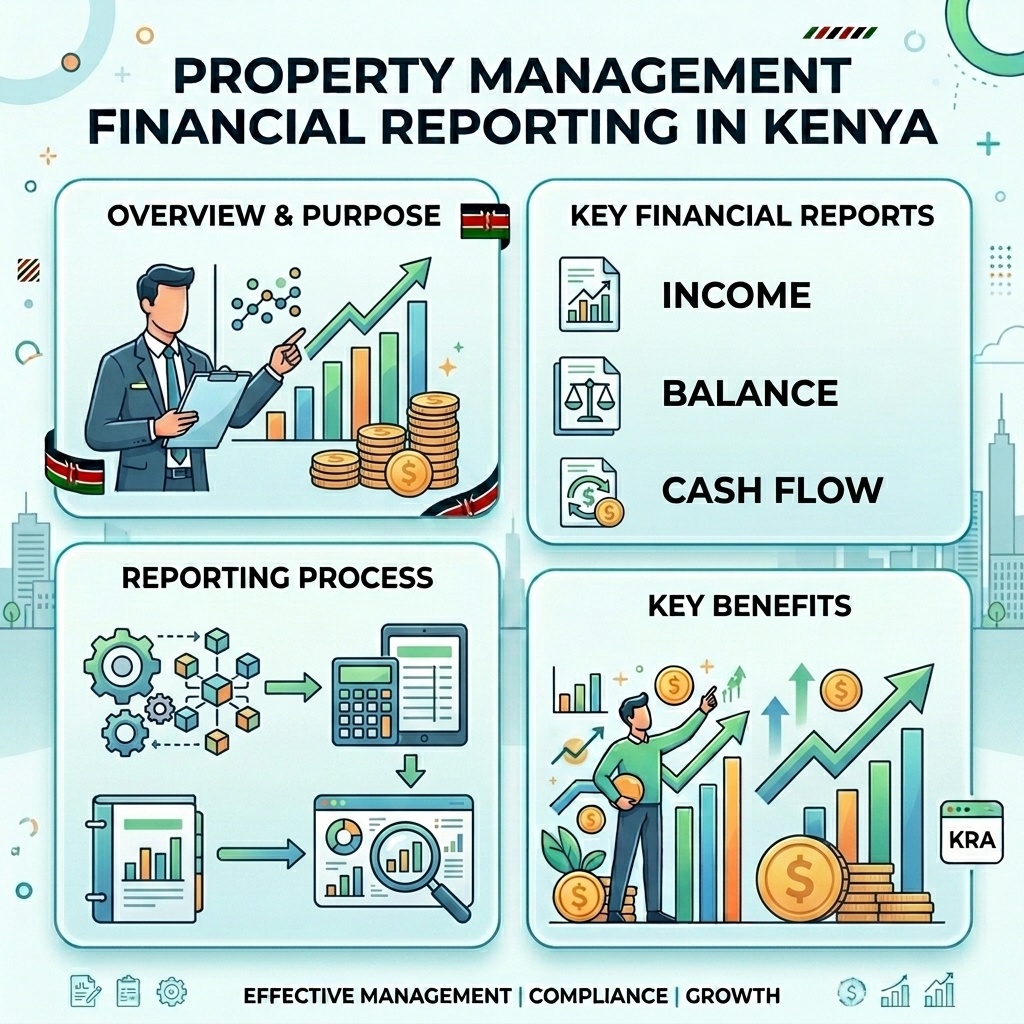
Financial reporting in property management refers to the structured recording and reconciliation of all financial activities related to rental properties, including tenant payments, expenses, and landlord distributions.
In property management financial reporting Kenya, the most important principle is separation of funds—landlord money must never be mixed with management revenue.
Core reporting components include:
Tenant rent collections and arrears tracking
Service charge contributions and usage
Maintenance and repair expenditures
Management fees and commissions
Landlord payouts and reconciliations
Each property must be treated as a separate financial unit to ensure transparency and audit compliance.
To strengthen reporting accuracy, many firms rely on structured bookkeeping services that ensure proper ledger control and reconciliation discipline.
In 2026, KRA enforcement frameworks increasingly rely on bank data matching and digital transaction tracking. In property management financial reporting Kenya, inconsistencies between declared rental income and actual bank inflows are now a primary audit trigger.
Property Management Financial Reporting Kenya: Structuring Rent Collection Systems
Rent collection is the most critical revenue stream in property management and must be tracked with precision. A strong system ensures that all tenant payments are recorded, reconciled, and verified against bank deposits.
Key components include:
Tenant ledger per unit and property
Monthly rent billing schedules
Digital payment tracking (M-Pesa, bank transfers, standing orders)
Monthly reconciliation reports
Arrears monitoring systems
Report Type
Purpose
Frequency
Tenant Rent Ledger
Tracks individual tenant payments
Monthly
Rent Roll Summary
Shows expected vs actual rent
Monthly
Arrears Report
Tracks overdue balances
Weekly
Bank Reconciliation
Matches receipts with deposits
Monthly
A properly structured property management financial reporting Kenya system ensures rent transparency and reduces revenue leakage across portfolios.
For scalability, firms often integrate structured bookkeeping systems to automate reconciliation processes.
KRA’s 2026 compliance systems increasingly flag mismatches between rental income declarations and financial institution data. Real-time reconciliation is now essential in property management financial reporting Kenya.
Property Management Financial Reporting Kenya: Service Charge Management and Transparency
Service charges are fiduciary funds collected from tenants for estate maintenance and operations. They must be fully transparent and separately managed from rental income.
Typical allocations include:
Security services
Cleaning and waste management
Water and electricity for common areas
Repairs and maintenance
Estate administration costs
To ensure compliance in property management financial reporting Kenya, property managers must maintain:
Separate service charge accounts
Monthly expense breakdown reports
Invoice-backed expenditure records
Reconciliation of unused balances
Service charges must never be treated as profit but as pass-through operational funds.
Property Management Financial reporting kenya: Estate Maintenance and Expense Control
Maintenance expenses directly affect profitability and require strict tracking across properties and units.
Proper maintenance ledgers must include:
Date of expense
Vendor and invoice details
Property/unit reference
Expense classification (repair or capital improvement)
Payment confirmation
Common risks include duplicate payments, missing invoices, and misclassified expenses.
Structured audit and assurance services help enforce discipline and prevent financial leakage in property management financial reporting Kenya systems.
Property Management Financial Reporting Kenya: Landlord Payouts and Trust Accounting
Landlord payouts represent the final step in the financial reporting cycle and must be fully reconciled before disbursement.
A proper payout structure includes:
Total rent collected
Less management fees
Less approved expenses
Service charge reconciliation
Net payable to landlord
In property management financial reporting Kenya, trust accounting principles ensure that landlord funds are protected and fully traceable.
KRA is increasing scrutiny on fund flows between tenants, property managers, and landlords. Detailed audit trails are now essential in property management financial reporting Kenya to avoid compliance disputes.
Property Management Financial Reporting Kenya: Compliance Framework in Kenya
Property managers must comply with IFRS standards, Kenyan Companies Act requirements, and evolving KRA tax regulations, including eTIMS integration.
From 2026 onward, KRA’s compliance systems integrate bank and mobile money data into tax verification frameworks, making accuracy in property management financial reporting Kenya critical.
Property Management Financial Reporting Kenya: Digital Transformation in Accounting
Digital transformation is reshaping property management accounting in Nairobi. Manual systems are being replaced with automated, cloud-based reporting structures.
Key developments include:
Cloud accounting platforms
Automated rent tracking systems
Digital invoicing and receipts
Payroll integration for estate staff
Real-time reporting dashboards
Digital systems improve accuracy and reduce compliance risk in property management financial reporting Kenya.
Manual reporting systems are becoming obsolete under KRA’s digital enforcement model. In property management financial reporting Kenya, failure to digitize increases audit exposure.
Property Management Financial Reporting Kenya: Common Reporting Mistakes
Frequent financial reporting mistakes include:
Mixing landlord and management funds
Failure to reconcile rent collections regularly
Inadequate arrears tracking
Missing supporting documentation
Incorrect expense classification
These errors compromise transparency in property management financial reporting Kenya and often lead to disputes or audit complications.
Structured knowledge resources via knowledge base tools improve financial discipline.
Even small inconsistencies in reporting can now trigger automated audit reviews under enhanced KRA monitoring systems.
Property Management Financial Reporting Kenya: Building a Scalable Reporting System
A scalable reporting system ensures consistency, compliance, and financial visibility across all properties.
As portfolios grow, regulators expect standardized reporting structures across all properties. Inconsistent systems increase audit risk exposure.
Conclusion: Financial Reporting as the Foundation of Property Management Success
In Nairobi’s evolving regulatory environment, financial reporting is the foundation of trust, compliance, and operational success in property management.
Strong systems ensure that every transaction is traceable, every expense is justified, and every landlord receives accurate reporting. Firms that invest in structured systems and digital transformation will remain compliant and competitive.
Ultimately, success in property management financial reporting Kenya depends on discipline, transparency, and continuous compliance alignment.
Gain Clarity and Confidence in Your Finances Navigate the complexities of compliance, tax, and financial management with a trusted partner. Adamjee Auditors, a member of Santa Fe Associates International (SFAI), provides world-class audit, tax, and advisory services to help your business achieve its goals.
Schedule a consultation with our expert team in Nairobi or Mombasa to discuss your business needs.
Nairobi Office
1st Floor, Le’Mac Building, Church Road, off Waiyaki Way, Westlands
Why must landlord funds be kept separate from management revenue?
Separation of funds is the most important principle in property management financial reporting because it keeps every shilling traceable, protects landlord money under trust accounting, and ensures transparency and audit compliance.
What reports should a Nairobi property manager produce for rent collection?
Core reports include a monthly tenant rent ledger per unit, a monthly rent roll summary showing expected versus actual rent, a weekly arrears report for overdue balances, and a monthly bank reconciliation matching receipts to deposits.
How are service charges supposed to be handled?
Service charges are fiduciary pass-through funds for items like security, cleaning, common-area utilities and repairs. They must be held in separate accounts with monthly expense breakdowns and invoice-backed records, and never recorded as profit.
What triggers a KRA audit in rental income reporting?
From 2026 KRA relies on bank data matching and digital transaction tracking, so inconsistencies between declared rental income and actual bank inflows are a primary audit trigger, making real-time reconciliation essential.
What compliance standards apply to property management financial reporting in Kenya?
Property managers must comply with IFRS standards, the Kenyan Companies Act, and evolving KRA tax regulations including eTIMS integration, while keeping accurate bookkeeping, compliant invoices, audit-ready statements and segregated client funds.