- The article sets out EBITDA multiples of 6x to 8x for businesses with clean audited financials, falling to 4x–6x with minor compliance gaps and 2x–4x where documentation issues are significant, with the deal withdrawn where tax exposure risk is high.
- Investor responses scale with severity: minor documentation gaps prompt a request for remediation before closing, material misstatements lead to a valuation reduction, tax exposure risk triggers escrow requirements, and systemic poor controls end the deal.
- In the enforcement environment from 1 January 2026, KRA validates expenses at invoice level through eTIMS integration, and expenses lacking eTIMS validation risk disallowance, revised tax liabilities, penalties and interest, and historical tax reassessments.
- The 2025 Finance Act strengthened digital enforcement and expanded KRA's automated audit systems, adding automated variance detection, real-time invoice cross-checking, enhanced related-party scrutiny and broader digital audit trails.
- KRA cross-matches payroll filings with individual tax records in 2026, so unremitted PAYE or NSSF, ghost employees, informal cash salaries and undocumented director compensation can trigger contingent liabilities and expose directors to personal risk.
- A pre-due diligence health check should cover bank reconciliation verification, an eTIMS compliance audit, tax exposure assessment, payroll compliance review, asset register validation and director loan reconciliation.
Investor capital does not disappear because of weak ideas. It disappears because of weak records.
In Kenya’s 2026 regulatory environment—characterized by eTIMS enforcement, automated KRA audits, and stricter Companies Act compliance—poor record-keeping is no longer an internal inconvenience. It is a deal breaker.
For founders, CEOs, and CFOs preparing for growth capital, private equity entry, debt restructuring, or strategic partnerships, the most dangerous risk is not market volatility—it is what investors call “the ghost in the ledger.”
At Adamjee Auditors, a member of SFAI Global, we routinely conduct financial due diligence reviews across Nairobi and Mombasa. The pattern is consistent: where records are incomplete, inconsistent, or unsupported, investor confidence collapses.
What Is “The Ghost in the Ledger”?
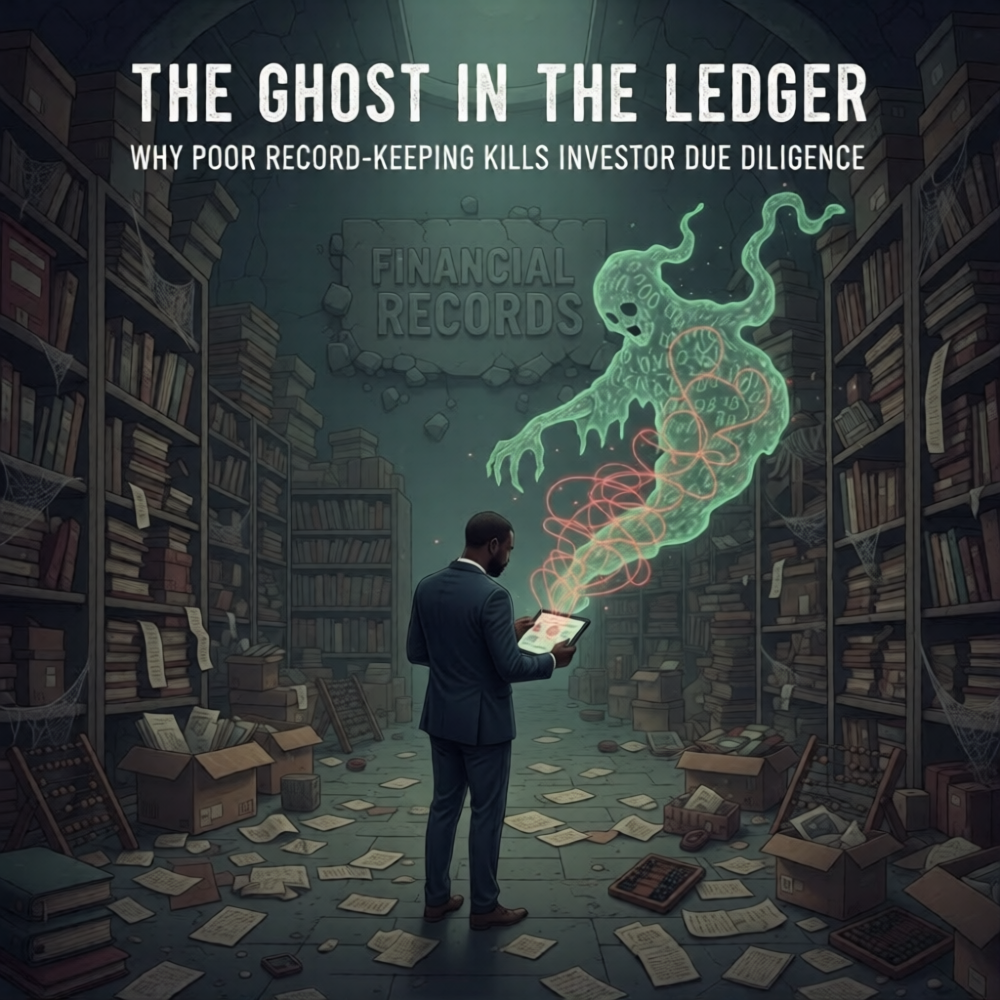
The “ghost in the ledger” refers to undocumented, unsupported, or poorly reconciled transactions that distort a company’s financial position.
These include:
-
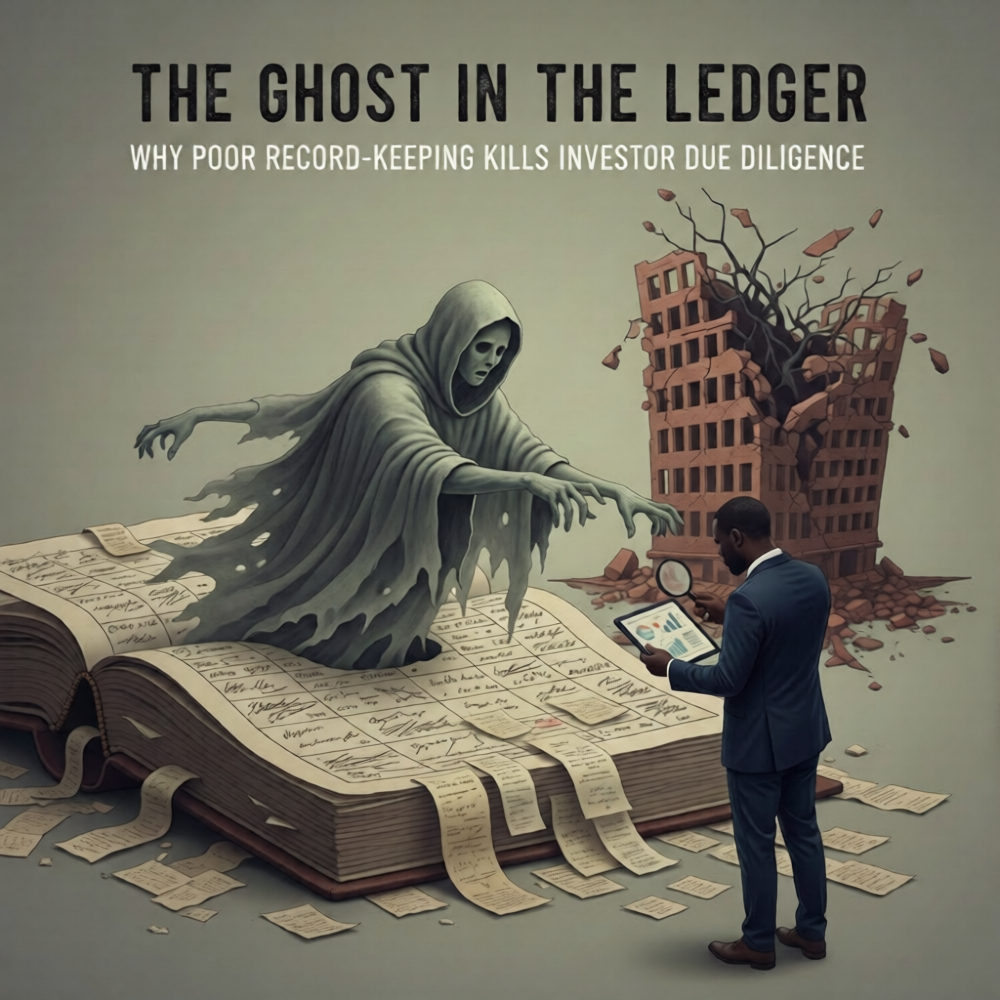
In Kenya’s 2026 compliance landscape, poor record-keeping doesn’t just raise red flags—it destroys investor confidence, slashes valuations, and can quietly kill your deal before it begins. Missing invoices
-
Unreconciled bank balances
-
Unsupported expense claims
-
Informal director withdrawals
-
Inconsistent asset registers
-
Payroll discrepancies
In 2026, these gaps are amplified by digital compliance systems. Under KRA’s strengthened eTIMS framework, expenses not backed by compliant invoices may be disallowed—directly affecting profitability and valuation.
During investor due diligence, financial statements are stress-tested against tax filings, payroll submissions, and statutory registers. Any mismatch raises immediate red flags.
For structured financial validation before fundraising, our Audit and Assurance Services provide independent credibility.
Why Investors Prioritize Financial Hygiene Over Growth Narratives
Investors understand projections are estimates. What they scrutinize is historical accuracy.
Due diligence focuses on:
-
Revenue recognition integrity
-
Expense validity
-
Tax compliance history
-
Payroll compliance
-
Asset ownership documentation
-
Related-party transactions
If management cannot reconcile revenue to bank deposits or explain discrepancies between VAT returns and income statements, investor risk perception increases dramatically.
The result is predictable:
| Issue Identified | Investor Response |
|---|---|
| Minor documentation gaps | Request remediation before closing |
| Material misstatements | Valuation reduction |
| Tax exposure risk | Escrow requirements |
| Systemic poor controls | Deal termination |
Strong bookkeeping is not administrative—it is strategic.
Our Bookkeeping Services ensure transaction-level integrity aligned with IFRS and Kenyan tax law.
How eTIMS in 2026 Changes Due Diligence Risk
The January 1, 2026 enforcement environment has fundamentally altered financial risk assessment.
KRA now validates expenses at invoice level through eTIMS integration. During due diligence, investors increasingly request:
-
eTIMS compliance confirmation
-
Reconciliation between eTIMS sales data and financial statements
-
Verification of input VAT claims
If expenses lack eTIMS validation, they risk disallowance. This may trigger:
-
Revised tax liabilities
-
Penalties and interest
-
Historical tax reassessments
Investors price this exposure into valuations.
Our Tax Compliance Services support proactive compliance reviews before investor engagement.
The Hidden Tax Bomb: Finance Act 2025 Implications
The 2025 Finance Act strengthened digital enforcement and expanded KRA’s automated audit systems.
For businesses with weak record-keeping, this creates cumulative risk:
-
Automated variance detection
-
Real-time invoice cross-checking
-
Enhanced related-party scrutiny
-
Broader digital audit trails
Investors now conduct “tax exposure mapping” during due diligence. If deferred tax liabilities are misstated due to poor asset records or incorrect capital allowance treatment, it directly affects enterprise value.
CFO-level oversight is critical. Our CFO Advisory Services help growth-stage companies institutionalize financial governance before external scrutiny.
How Poor Payroll Records Undermine Investor Confidence
Payroll inconsistencies often reveal deeper governance weaknesses.
Common issues include:
-
Unremitted PAYE or NSSF
-
Ghost employees
-
Informal cash salary payments
-
Director compensation not properly documented
In 2026, KRA cross-matches payroll filings with individual tax records. Investors are aware of this digital transparency.
Payroll compliance failures can:
-
Trigger contingent liabilities
-
Expose directors to personal risk
-
Delay transaction completion
Our Payroll Services ensure compliant workforce scaling.
IFRS, Companies Act, and the Due Diligence Lens
Under the Kenyan Companies Act and IFRS standards, directors are responsible for maintaining proper books of account.
During due diligence, investors review:
-
Compliance with IFRS
-
Deferred tax accuracy
-
Fixed asset register integrity
-
Inventory valuation methodology
-
Going concern assessments
Failure to maintain statutory records may constitute a governance breach.
Businesses preparing for their first audit should review our First Financial Audit in Kenya Guide to understand expectations.
For statutory requirements, see our detailed Statutory Audit Kenya Guide.
Related-Party Transactions: A Major Due Diligence Red Flag
In family-owned and founder-led businesses, related-party transactions are common—but often undocumented.
Examples include:
-
Shareholder loans without agreements
-
Director expenses mixed with company costs
-
Equipment leased informally between related entities
The 2025 Finance Act strengthened scrutiny of such arrangements, especially where transfer pricing implications arise.
During due diligence, investors demand:
-
Formal agreements
-
Arm’s-length pricing evidence
-
Clear disclosure in financial statements
Weak documentation can suggest governance risk—even where no fraud exists.
Offshore Operations and Cross-Border Complexity
Kenyan businesses operating across East Africa or globally face additional record-keeping expectations.
Investors require:
-
Consolidated financial statements
-
Foreign currency translation compliance
-
Transfer pricing documentation
-
Offshore entity tax alignment
Our Offshore Accounting Services support multi-jurisdictional compliance, backed by the global expertise of SFAI Global.
International standards combined with local expertise significantly enhance investor trust.
How Poor Record-Keeping Impacts Valuation
Valuation models—whether EBITDA multiples or discounted cash flow—depend on credible data.
When records are unreliable, investors apply:
-
Higher risk premiums
-
Lower earnings multiples
-
Contingency holdbacks
-
Escrow arrangements
Consider the following scenario:
| Financial Condition | EBITDA Multiple |
|---|---|
| Clean audited financials | 6x – 8x |
| Minor compliance gaps | 4x – 6x |
| Significant documentation issues | 2x – 4x |
| High tax exposure risk | Deal withdrawn |
The cost of poor bookkeeping can exceed the cost of professional compliance many times over.
To strengthen credibility, learn more About Adamjee Auditors and our governance-focused advisory approach.
Pre-Due Diligence Health Check: A Strategic Imperative
Before engaging investors, businesses should conduct an internal due diligence simulation.
This includes:
-
Bank reconciliation verification
-
eTIMS compliance audit
-
Tax exposure assessment
-
Payroll compliance review
-
Asset register validation
-
Director loan reconciliation
Our Knowledge Base offers technical insights to prepare leadership teams for scrutiny.
A structured pre-due diligence review transforms negotiation dynamics. Instead of defending inconsistencies, management presents clarity and control.
The Governance Signal Investors Look For
Ultimately, investor due diligence is less about numbers and more about governance discipline.
Investors ask:
-
Are records maintained consistently?
-
Are tax filings aligned with financial statements?
-
Is there segregation of duties?
-
Are board minutes documented?
-
Are statutory filings current?
Strong governance signals lower risk, enabling better capital terms.
Our integrated Audit and Assurance Services and advisory solutions help businesses institutionalize these controls.
Poor record-keeping does not simply create compliance headaches—it erodes investor confidence, reduces valuation, and in many cases, kills deals entirely.
In Kenya’s 2026 digital compliance environment, transparency is no longer optional. eTIMS validation, Finance Act enforcement, automated KRA systems, and IFRS governance standards have raised the bar.
Businesses seeking capital must move from informal financial management to institutional-grade governance.
At Adamjee Auditors, we combine:
-
Local regulatory expertise
-
IFRS-compliant audit rigor
-
Proactive tax structuring
-
Global insight through SFAI Global
The result is credibility investors trust—and growth capital secured with confidence.