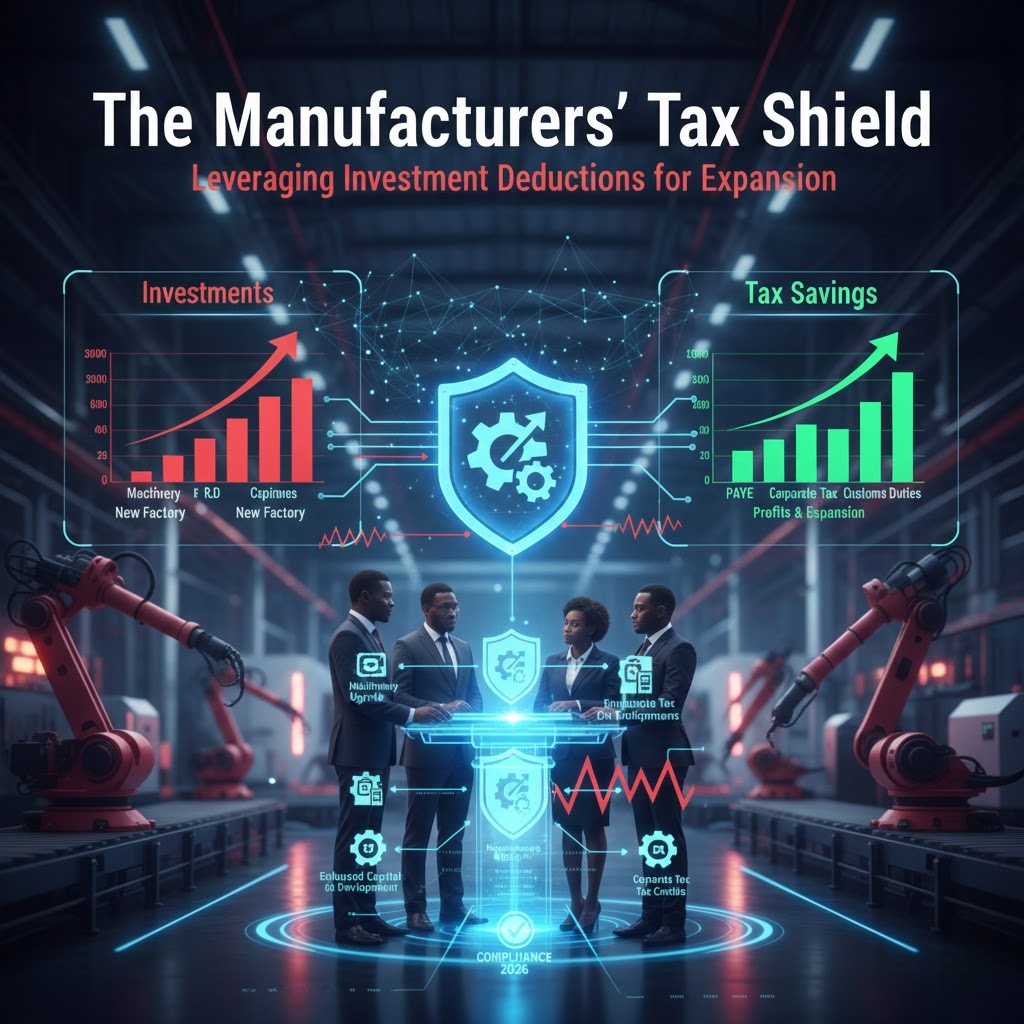
- A manufacturers' tax shield legally reduces corporate income tax through investment deductions, capital allowances, and accelerated depreciation on qualifying assets under the Income Tax Act (Cap 470).
- Key claims include the Investment Deduction Allowance (IDA), Industrial Building Allowance (IBA), and Wear and Tear Allowances (WTA); in certain zones such as EPZs, IDA may be claimed at 100% in the first year.
- From January 1, 2026, capital assets not supported by compliant eTIMS invoices may be disallowed as deductible expenses or capital claims during KRA review.
- IFRS depreciation and tax capital allowances follow different rules, creating timing differences and deferred tax, so dual schedules and an annually reconciled fixed asset register are essential.
- Incorrect claims expose manufacturers to additional assessments, penalties (typically 20%), and statutory interest; common red flags include excessive first-year deductions and capitalized repairs.
Manufacturers’ Tax Shield,Kenya’s manufacturing sector is central to the country’s industrialization agenda under Vision 2030 and the Bottom-Up Economic Transformation Agenda (BETA). Yet, for many manufacturers, the biggest barrier to expansion is capital intensity—plant, machinery, warehousing, technology upgrades, and compliance systems all demand significant upfront investment.
Strategically leveraging investment deductions and capital allowances under Kenyan tax law can transform expansion from a financial burden into a structured, tax-efficient growth plan. In 2026, with stricter eTIMS enforcement and evolving KRA audit automation, understanding how to properly claim these incentives is no longer optional—it is a competitive necessity.
As Adamjee Auditors, a member of SFAI Global, we advise manufacturers across Nairobi, Mombasa, and export processing zones on structuring investments to maximize tax shields while remaining fully compliant with IFRS and KRA requirements.
What Is the Manufacturers’ Tax Shield in Kenya?
A manufacturer’s tax shield refers to legally reducing corporate income tax through investment deductions, capital allowances, and accelerated depreciation on qualifying assets.
Under the Income Tax Act (Cap 470), manufacturers can claim:
-
Investment Deduction Allowance (IDA)

-
Industrial Building Allowance (IBA)
-
Wear and Tear Allowances (WTA)
-
Farm Works and Environmental Expenditure (where applicable)
These provisions allow capital-intensive industries to recover costs faster, reducing effective tax rates in early expansion years.
Adamjee Advisory Insight (2026 Context)
With the January 1, 2026 eTIMS enforcement rules, any capital asset not supported by a compliant eTIMS invoice may be disallowed as a deductible expense or capital claim during a KRA review. This has materially increased tax risk for manufacturers purchasing machinery from non-compliant suppliers.
Manufacturers must align procurement, accounting, and tax strategy before committing to large capital investments.
For structured validation of capital expenditure treatment, explore our Audit and Assurance Services.
Which Investment Deductions Can Manufacturers Claim in 2026?
Manufacturers in Kenya can claim substantial deductions depending on the type and location of investment.
1. Investment Deduction Allowance (IDA) of Manufacturers’ Tax Shield
Typically available for:
-
Manufacturing plants
-
Machinery installed in industrial buildings
-
Buildings used for manufacturing
In certain zones, including EPZs and priority counties, IDA may be claimed at 100% in the first year.
2. Industrial Building Allowance (IBA) of Manufacturers’ Tax Shield
Applicable to:
-
Factories
-
Godowns
-
Warehouses
3. Wear and Tear Allowances
Applies to:
-
Plant and machinery
-
Motor vehicles
-
Office equipment
-
Computer hardware
| Asset Category | Typical WTA Rate |
|---|---|
| Heavy Machinery | 37.5% / 12.5% |
| Motor Vehicles | 25% |
| Computers & IT | 30% |
| Furniture & Equipment | 12.5% |
Proper classification is critical. Misclassification frequently triggers KRA audit adjustments and reassessments.
For implementation support, consult our Tax Compliance and Advisory Services.
How Does the 2025 Finance Act Affect Manufacturers?
The 2025 Finance Act significantly strengthened digital tax administration and enforcement mechanisms.
Key Changes Affecting Manufacturers
-
Strengthened digital invoice validation via eTIMS
-
Expanded penalties for unsupported expenses
-
Increased scrutiny on related-party transactions
-
Greater automation in VAT refund reviews
The regulatory shift means tax compliance is now integrated into operational systems. Manufacturers must:
-
Integrate ERP systems with eTIMS
-
Reconcile asset registers monthly
-
Align IFRS depreciation with tax capital allowance schedules
Our CFO Advisory Services help finance leaders design compliant, tax-efficient capital strategies.
How Does eTIMS Impact Investment Deduction Claims in 2026?
The 2026 regulatory environment emphasizes invoice-level verification. Capital assets must be supported by eTIMS-compliant documentation to qualify for deduction.
Manufacturers must ensure:
-
Suppliers are eTIMS compliant
-
All invoices are validated within KRA systems
-
Asset capitalization matches invoice records
Failure to align documentation may result in:
-
Denied capital allowances
-
Additional tax assessments
-
Penalties and interest
Manufacturers should conduct periodic compliance reviews. Our KRA Audit Survival Guide provides structured preparation strategies.
Can Manufacturers Use the KRA Automated Payment Plan (APP) Strategically?
The 2026 KRA Automated Payment Plan (APP) provides structured settlement options for tax arrears. While it does not eliminate tax liability, it assists with cash flow management.
Manufacturers facing:
-
VAT arrears
-
Corporate tax adjustments
-
PAYE liabilities
may qualify for APP arrangements subject to accurate disclosures and filing history.
Workforce expansion also increases payroll compliance exposure. Learn more about our Payroll Services to manage growing teams efficiently.
How Should Manufacturers Align IFRS and Tax Capital Allowances?
IFRS depreciation reflects the economic useful life of assets, while tax capital allowances follow statutory rates prescribed by Kenyan tax law. This difference creates temporary timing variances and deferred tax implications.
Common errors include:
-
Using IFRS depreciation as the tax deduction
-
Failing to reconcile the fixed asset register annually
-
Ignoring impairment versus tax treatment differences
Maintaining dual schedules is essential for accurate reporting and audit readiness.
Our Bookkeeping Services ensure asset registers, tax schedules, and compliance records are properly maintained.
What Expansion Structures Optimize the Tax Shield?
Entity structuring significantly influences tax outcomes during expansion.
Options include:
-
Separate Special Purpose Vehicles (SPVs) for new plants
-
Export Processing Zone registration
-
Offshore procurement structures
For manufacturers operating across borders, our Offshore Accounting Services support international compliance and reporting.
As a member of SFAI Global, Adamjee Auditors combines international standards with deep local regulatory expertise.
What Are the Risks of Incorrect Investment Deduction Claims?
Incorrect claims expose manufacturers to additional assessments, penalties (typically 20%), and statutory interest.
Common red flags include:
-
Excessive first-year deductions
-
Capitalized repairs treated as investment
-
Unsupported contractor payments
-
Related-party equipment purchases without transfer pricing documentation
For audit preparation, refer to our Statutory Audit Kenya Guide.
How Can Manufacturers Build a Sustainable Tax Strategy?
Tax efficiency must be embedded in long-term strategy rather than addressed reactively at year-end.
A best-practice framework includes:
-
Pre-investment tax modeling
-
eTIMS supplier verification
-
Automated asset register management
-
Monthly compliance reviews
-
Independent annual audit
Understanding your advisory partner is critical. Learn more About Adamjee Auditors and how we support manufacturing growth.
Stay updated through our Training and Webinars for regulatory insights.
The Kenyan tax framework offers powerful tools to reduce expansion costs through investment deductions and capital allowances. However, with enhanced eTIMS enforcement, Finance Act reforms, and automated KRA audits in 2026, improper structuring can create significant exposure.
Adamjee Auditors combines:
-
Local regulatory expertise
-
IFRS-aligned reporting
-
KRA audit readiness
-
Global technical depth through SFAI Global
International standards. Local expertise. Strategic growth.