- Cloud migration moves financial data, processes, and workflows from desktop software to secure cloud platforms, enabling real-time access, automation, automatic backups, and stronger controls.
- Desktop systems waste up to 20 hours a month via manual data transfers and re-keying, single-machine access bottlenecks, delayed month-end closes, and IT or maintenance downtime.
- The lost time is a hard cost: for a finance officer earning KES 120,000 per month, 20 lost hours is about 12.5% of work time, with annual productivity loss exceeding a full working month plus management waiting time and consultant fees.
- From January 1, 2026, expenses not supported by valid eTIMS invoices are disallowed, and cloud systems make it easier to link expenses to eTIMS invoices, keep audit-ready records, and reconcile VAT accurately.
- Successful cloud migration is a management-led transformation requiring clear objectives, staff training and change management, and careful system selection aligned with size, complexity, IFRS reporting, and eTIMS compatibility.
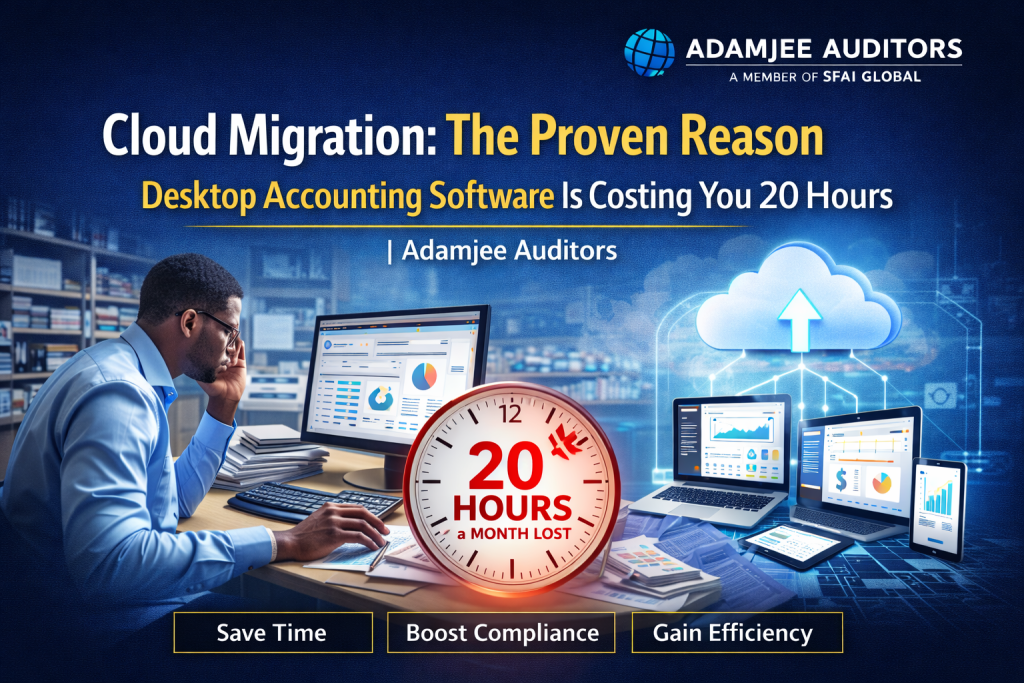
Cloud Migration: The Proven Reason Desktop Accounting Software Is Costing You 20Cloud Migration
For many Kenyan businesses, desktop accounting software feels familiar, reliable, and “good enough.” It sits on an office computer, someone backs it up occasionally, and the finance team works around its limitations. Yet behind this familiarity is a hidden operational cost that most CEOs and CFOs underestimate: lost time.
Cloud migration is no longer a technology upgrade—it is a productivity, compliance, and cost-control decision. Kenyan businesses using desktop accounting software routinely lose up to 20 hours a month through manual processes, delayed reporting, duplicated work, and access limitations. Over a year, this inefficiency compounds into higher payroll costs, weaker controls, and slower decision-making.
Adamjee Auditors, a member of the SFAI Global network, advises Kenyan businesses on cloud migration as part of broader finance transformation—linking accounting systems to compliance, reporting accuracy, and strategic growth.
What Cloud Migration Means for Accounting Systems
Cloud migration in accounting involves moving financial data, processes, and workflows from desktop-based software to secure, cloud-based platforms. This enables real-time access, automation, and stronger controls across the finance function.
Unlike desktop systems that are tied to a single device or location, cloud accounting platforms allow authorized users to access data anytime, anywhere, with automatic updates and backups.
Desktop vs Cloud Accounting: A Structural Difference
| Area | Desktop Accounting | Cloud Accounting |
|---|---|---|
| Access | Single machine or local network | Anywhere, anytime |
| Updates | Manual | Automatic |
| Collaboration | Limited | Real-time |
| Backups | Manual or inconsistent | Automatic |
| Scalability | Restricted | Flexible |
Adamjee Advisory Insight: Many Kenyan firms think they “don’t need” cloud accounting—until growth, audits, or KRA requirements expose the limitations of desktop systems.
Where Desktop Accounting Software Wastes 20 Hours a Month
The time cost of desktop accounting comes from small inefficiencies that accumulate every week. These losses are rarely tracked but significantly affect productivity.
1. Manual Data Transfers
Desktop systems often require:
-
Manual imports from POS systems
-
Spreadsheet reconciliations
-
Re-keying payroll or inventory data
Each manual step introduces delays and errors.
2. Limited Access and Bottlenecks
When only one person or one machine can access the accounting system:
-
Reporting waits for availability
-
Approvals are delayed
-
Management decisions slow down
3. Delayed Financial Reporting
Month-end closes take longer because data is fragmented and not updated in real time.
4. IT and Maintenance Downtime
System crashes, corrupted files, and failed backups cost hours in recovery time.
When finance teams track time honestly, they often exceed 20 lost hours per month—especially in multi-branch or growing businesses.
The Financial Cost of Lost Accounting Time
Time lost in accounting systems directly translates into higher operating costs and weaker financial control. It is not a “soft” cost.
Consider a finance officer earning KES 120,000 per month:
-
20 hours lost = ~12.5% of monthly work time
-
Annual productivity loss exceeds one full working month
This does not include:
-
Management time spent waiting for reports
-
External consultant fees to fix errors
-
Opportunity cost of delayed decisions
Cloud migration is often justified on cost savings alone—before even considering compliance and control benefits.
Cloud Migration and Financial Control
Cloud accounting strengthens financial control by improving visibility, accountability, and audit trails. These controls are increasingly important under Kenyan regulatory scrutiny.
Key control improvements include:
-
User-based access permissions
-
Automatic transaction logs
-
Real-time reconciliations
-
Reduced manual overrides
These controls are critical during audits and management reviews.
Adamjee Auditors integrates cloud accounting with audit and assurance services to ensure systems support reliable financial reporting.
Compliance Benefits Under Kenyan Tax and Regulatory Frameworks
Cloud accounting supports better compliance with KRA, IFRS, and the Companies Act by improving accuracy and traceability.
eTIMS and Expense Validation (2026)
From January 1, 2026:
-
Expenses not supported by valid eTIMS invoices are disallowed
-
KRA increasingly relies on automated data matching
Cloud systems make it easier to:
-
Link expenses to eTIMS invoices
-
Maintain audit-ready documentation
-
Reconcile VAT accurately
Businesses working with tax compliance advisory are better positioned to configure cloud systems correctly from the start.
Cloud Migration and Month-End Close Efficiency
Cloud accounting significantly shortens the month-end close cycle. Faster closes mean better decisions.
Cloud systems enable:
-
Real-time bank feeds
-
Automated journal entries
-
Continuous reconciliations
Instead of “closing” accounts weeks after month-end, management can review near-real-time performance.
Faster closes reduce reliance on estimates and improve confidence in financial data used by boards and investors.
Supporting Multi-Branch and Remote Operations
Cloud accounting is essential for businesses with multiple branches, remote teams, or offshore operations.
Desktop accounting struggles when:
-
Branches submit data late
-
Head office consolidates manually
-
Overseas teams cannot access systems
Cloud platforms support centralized reporting while allowing controlled local access.
This aligns naturally with offshore accounting services for Kenyan firms expanding regionally or globally.
Risk Reduction Through Cloud-Based Accounting
Cloud systems reduce operational and data risks associated with desktop software.
Key risk reductions:
-
Automatic backups reduce data loss
-
Encrypted access improves security
-
Reduced dependency on a single staff member
Many Kenyan businesses only realize their data risk after a system failure or staff exit. Cloud migration addresses this proactively.
The Role of Management in Successful Cloud Migration
Cloud migration is a management-led transformation, not just an IT project.
Successful migration requires:
-
Clear objectives (speed, control, compliance)
-
Staff training and change management
-
Policy updates and process redesign
Adamjee Auditors supports leadership teams through migration planning and execution via CFO advisory services.
Choosing the Right Cloud Accounting Setup
Not all cloud accounting solutions are suitable for every business. Selection must align with size, complexity, and compliance needs.
Key considerations:
-
Integration with payroll and inventory
-
IFRS reporting capabilities
-
eTIMS compatibility
-
Scalability for growth
Poor system selection can create new inefficiencies instead of eliminating old ones.
Cloud Migration as a Strategic Advantage
Cloud migration transforms accounting from a back-office function into a strategic management tool.
With real-time data, management can:
-
Monitor performance continuously
-
Respond faster to risks
-
Plan cash flow accurately
-
Support growth decisions confidently
This is where accounting shifts from record-keeping to value creation.
Conclusion
Desktop accounting software is quietly costing Kenyan businesses time, money, and control. Cloud migration is the proven solution to reclaim lost hours and strengthen financial management.
The 20 hours lost each month are not inevitable—they are the result of outdated systems misaligned with modern business and regulatory realities. Cloud migration improves efficiency, enhances compliance, reduces risk, and positions finance teams to support strategic growth.
Adamjee Auditors combines deep Kenyan regulatory expertise with SFAI Global best practices to guide businesses through cloud migration—ensuring systems deliver accuracy, control, and long-term value.
Gain Clarity and Confidence in Your Finances
Navigate the complexities of compliance, tax, and financial management with a trusted partner. Adamjee Auditors, a member of Santa Fe Associates International (SFAI), provides world-class audit, tax, and advisory services to help your business achieve its goals.
Schedule a consultation with our expert team in Nairobi or Mombasa to discuss your business needs.
Nairobi Office 1st Floor, Le’Mac Building, Church Road, off Waiyaki Way, Westlands
+254 717 908 241
info@adamjeeauditors.com
Mombasa Office Suite 401, Motorwalla Building, Jomo Kenyatta Road
+254 703 899 606 / +254 717 908 241
info@adamjeeauditors.com
https://adamjeeauditors.com/