
- ESOPs grant employees company shares immediately or over a vesting period (typically 3-5 years), turning staff into stakeholders to improve loyalty and reduce turnover costs.
- They are tax-efficient because employees generally defer tax until shares are exercised or sold, with potential capital gains treatment, and grants do not trigger PAYE until exercised.
- ESOPs must be drafted under the Companies Act 2015, comply with IFRS 2 for share-based payments, and meet KRA eTIMS and APP requirements from January 1, 2026.
- Companies can deduct ESOP setup, trustee, and legal costs, but exercise-price payments and share buybacks must be documented with eTIMS invoices or the expenses are disallowed.
- Funding options include issuing new shares (dilutive), allocating existing shares (needs shareholder approval), or loan-backed shares, each with different tax and accounting implications.
Employee Share Ownership Plans (ESOPs): The Tax-Efficient Way to Retain Top Talent
Employee retention is one of the most pressing challenges for Kenyan businesses today. High employee turnover not only disrupts operations but also increases recruitment and training costs. Employee Share Ownership Plans (ESOPs) offer a tax-efficient mechanism to retain top talent while aligning employee interests with long-term company growth. By providing employees with equity, businesses can incentivize performance, improve loyalty, and achieve sustainable growth.
Adamjee Auditors, a member of the SFAI Global network, specializes in helping Kenyan businesses structure ESOPs that are both legally compliant under the Companies Act 2015 and tax-efficient under the latest KRA eTIMS and APP regulations.
What is an ESOP and How Does It Work?
An ESOP is a formal employee benefit plan that grants company shares to employees. It aligns employee interests with company performance, improves retention, and offers potential tax benefits under Kenyan law. Properly structured, ESOPs can incentivize long-term value creation while remaining fully compliant with the Companies Act and KRA rules.
An ESOP allows employees to acquire shares in the company they work for, either immediately or over a vesting period. Companies can issue new shares or allocate existing shares to an ESOP trust, with a defined plan governing eligibility, vesting schedules, and exercise terms.
Key Components of an ESOP
| Component | Description |
|---|---|
| Vesting Period | Duration an employee must stay before acquiring full ownership of shares. |
| Exercise Price | Price at which employees can purchase shares; may be discounted. |
| ESOP Trust | Entity that holds shares on behalf of employees. |
| Dividends | Employees may receive dividends before or after exercising options. |
| Exit Strategy | Terms for employees selling shares back to the company or on the market. |
Adamjee Advisory Insight: Under the January 1, 2026 KRA regulation, ESOP-related transactions must be recorded with supporting eTIMS invoices for any exercise price payments or share buybacks. Expenses not documented in eTIMS are disallowed for tax purposes.
Tax Benefits of ESOPs in Kenya
ESOPs provide tax efficiency by deferring income recognition and offering exemptions under certain conditions. Employees may benefit from capital gains treatment rather than ordinary income tax, while companies can leverage deductions for administrative costs.
Employee Tax Considerations
-
Deferred Taxation: Employees typically do not pay tax on ESOP shares until exercised or sold, allowing capital growth without immediate tax liability.
-
Capital Gains Treatment: Upon sale of shares, profits may be taxed under the Kenyan capital gains tax regime, which can be lower than income tax.
-
KRA Compliance: Any share transactions must align with the 2026 eTIMS and Automated Payment Plan (APP) regulations to avoid penalties.
Company Tax Considerations
-
Administrative Cost Deduction: Companies can deduct ESOP setup, trustee fees, and legal costs.
-
No Immediate Payroll Tax: Unlike cash bonuses, ESOP grants do not trigger PAYE until shares are exercised.
-
Incentive Alignment: Retaining key employees via ESOPs can reduce costly turnover-related expenses, indirectly improving taxable profits.
Adamjee Advisory Insight: Kenyan SMEs implementing ESOPs should consult a tax advisory specialist to structure share allocation, vesting schedules, and eTIMS documentation in compliance with the Finance Act 2025 and January 2026 KRA guidelines.
Designing an ESOP for Kenyan Companies
A successful ESOP requires clear objectives, proper legal structuring, and robust administrative oversight. Decisions on share allocation, vesting, and exit mechanisms should be guided by both strategic and regulatory considerations.
Step 1: Determine the Objectives
-
Retention of key staff
-
Performance incentives
-
Alignment of employee and shareholder interests
Step 2: Legal and Regulatory Compliance
-
Draft ESOP scheme under the Companies Act 2015
-
Ensure alignment with IFRS 2 for share-based payments
-
File required returns with KRA and maintain eTIMS compliance
Step 3: Funding the ESOP
Options include:
| Funding Method | Pros | Cons |
|---|---|---|
| New Shares | Expands equity; preserves cash | Dilutes existing shareholders |
| Existing Shares | No dilution | Requires shareholder approval |
| Loan-Backed Shares | Employees acquire shares via loan | Complex accounting and tax compliance |
Step 4: Vesting and Exit
-
Standard vesting period: 3–5 years
-
Exit options: company buyback, third-party sale, or IPO
-
Clear communication of exit rules is critical for transparency and employee confidence
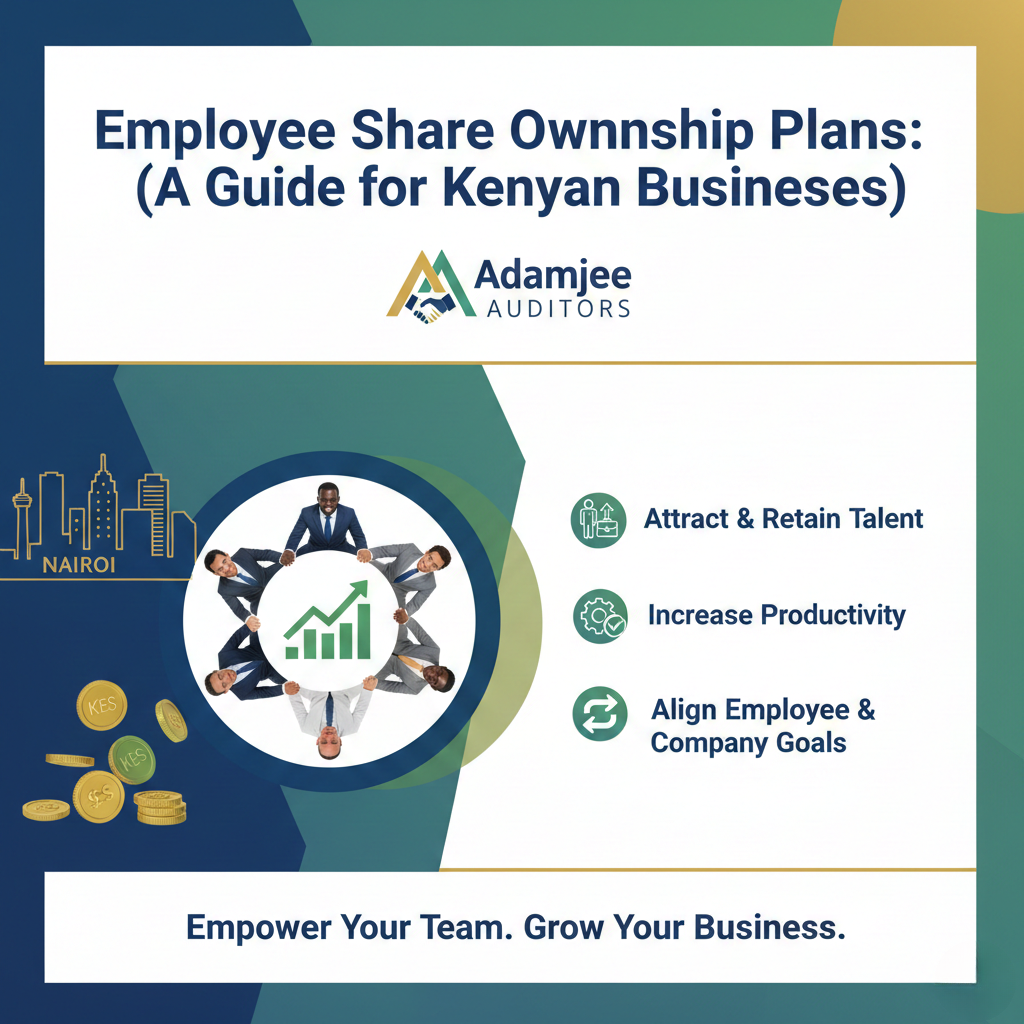
Structuring vesting schedules in line with the Companies Act and KRA reporting ensures employees cannot claim shares prematurely, and the company remains compliant with 2026 expense validation rules.
ESOPs as a Retention Tool
ESOPs motivate employees to stay longer and contribute to company success. By giving employees an ownership stake, businesses can foster loyalty, increase engagement, and reduce turnover costs.
-
Employees with equity are more likely to align their goals with long-term company success.
-
ESOPs can act as a differentiator in competitive sectors like tech, finance, and professional services.
-
Retention is enhanced because employees must wait for full vesting to realize financial gains.
KRA recognizes deferred share-based compensation under ESOPs as a legitimate tax planning tool when properly documented with eTIMS, encouraging businesses to retain high-value employees.
Accounting and Reporting for ESOPs
ESOP accounting requires proper recognition of share-based payments and fair value disclosures. Companies must comply with IFRS 2 and maintain accurate records for KRA audit purposes.
Key Accounting Requirements
-
Grant Date Recognition: Calculate the fair value of the options at grant date.
-
Expense Recognition: Spread the expense over the vesting period.
-
Disclosure: Include details of share options, assumptions, and valuation methods in financial statements.
| IFRS 2 Requirement | Practical Application in Kenya |
|---|---|
| Measurement | Fair value at grant date, usually via Black-Scholes or similar model |
| Expense Period | Vesting period recognition over 3–5 years |
| Disclosure | Notes on number of options, exercise price, and vesting schedule |
Regular bookkeeping and payroll integration can simplify ESOP accounting. Adamjee Auditors offers comprehensive bookkeeping services and payroll services to maintain compliance with both IFRS and KRA requirements.
ESOPs vs Cash Bonuses
ESOPs are generally more tax-efficient and retention-focused than cash bonuses. While cash rewards are immediately taxable, ESOPs defer tax liability, tie compensation to company growth, and create long-term incentives.
| Feature | Cash Bonus | ESOP |
|---|---|---|
| Taxation | Immediate PAYE | Deferred until exercise or sale |
| Retention Impact | Short-term | Long-term |
| Alignment with Growth | None | Directly tied to company performance |
| Cost to Company | Immediate cash outflow | Spread over vesting period |
SMEs in Kenya should weigh ESOPs for key talent retention, especially where cash flow is limited. Proper structuring ensures both compliance with tax compliance advisory and employee satisfaction.
Implementing ESOPs in Practice
Implementation requires careful planning, legal compliance, and effective communication with employees. Partnering with experts like Adamjee Auditors ensures that Kenyan businesses meet regulatory requirements while achieving strategic HR goals.
Steps for Successful Implementation
-
Draft the ESOP scheme in consultation with legal counsel.
-
Obtain shareholder and board approvals.
-
Communicate the plan clearly to eligible employees.
-
Maintain proper eTIMS documentation for all transactions.
-
Integrate with payroll and accounting systems.
Adamjee Auditors provides end-to-end support from audit and assurance services to ESOP plan design, ensuring compliance with 2026 KRA rules, Companies Act, and IFRS standards.
Common Pitfalls to Avoid
Failure to document, communicate, or comply with KRA regulations can invalidate an ESOP and create tax liabilities. Companies must ensure proper eTIMS records, legal approvals, and IFRS accounting treatment.
-
Delayed or missing eTIMS invoices for share transactions
-
Overly complex vesting schedules that confuse employees
-
Ignoring IFRS 2 disclosure requirements
-
Poor integration with payroll and HR systems
Engaging CFO advisory services can prevent compliance gaps and optimize the ESOP structure for maximum tax efficiency and employee retention.
Real-World Benefits of ESOPs
Well-structured ESOPs create measurable business value through improved retention, productivity, and alignment with shareholder goals. Kenyan businesses can leverage ESOPs to attract talent and foster a performance-oriented culture.
Case Example (Hypothetical)
-
Company X implemented an ESOP for senior management.
-
Employee turnover dropped by 40% over 3 years.
-
Company profitability increased by 25% due to alignment of incentives.
-
Tax compliance was achieved with all transactions documented under eTIMS and verified by Adamjee Auditors.
ESOPs are a strategic, tax-efficient tool to retain top talent in Kenya. When properly structured, compliant with KRA and Companies Act regulations, and integrated with accounting and payroll systems, they deliver measurable benefits to both employees and businesses.
Adamjee Auditors combines local expertise and SFAI Global standards to help Kenyan companies implement ESOPs effectively, ensuring full compliance with 2026 tax, eTIMS, and accounting requirements.
Gain Clarity and Confidence in Your Finances
Navigate the complexities of compliance, tax, and financial management with a trusted partner. Adamjee Auditors, a member of Santa Fe Associates International (SFAI), provides world-class audit, tax, and advisory services to help your business achieve its goals.
Schedule a consultation with our expert team in Nairobi or Mombasa to discuss your business needs.
Nairobi Office 1st Floor, Le’Mac Building, Church Road, off Waiyaki Way, Westlands +254 717 908 241 info@adamjeeauditors.com
Mombasa Office Suite 401, Motorwalla Building, Jomo Kenyatta Road +254 703 899 606 / +254 717 908 241 info@adamjeeauditors.com https://adamjeeauditors.com/