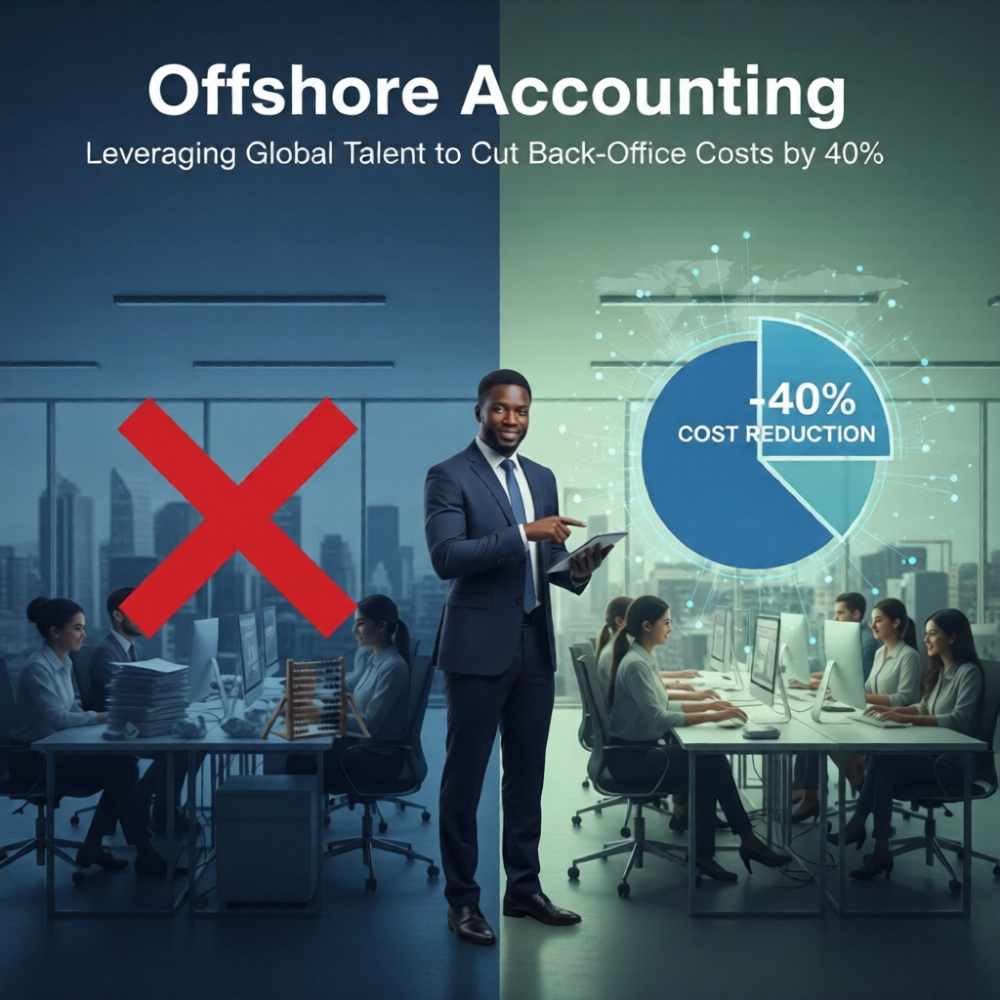
- An offshore financial controller delivers executive-level financial governance remotely, letting businesses scale without the cost of full-time in-house finance leadership.
- Unlike standard accountants, controllers focus on financial strategy, reporting integrity, budgeting systems and compliance architecture, turning data into actionable business intelligence.
- Core responsibilities include IFRS-aligned financial reporting and variance analysis, budgeting and forecasting, internal controls and risk management, and statutory and tax compliance.
- They solve scaling challenges by standardizing reporting, improving cash flow visibility, enhancing budget discipline and ensuring audit readiness across entities.
- In Kenya the role is increasingly relevant because the KRA uses digital systems such as eTIMS and automated data matching to reconcile financial statements with tax filings, making accuracy and consistency critical.
Understanding Offshore Financial Controller Services
An offshore financial controller is a senior finance professional who provides strategic financial oversight remotely. The role sits between operational accounting and CFO-level leadership, ensuring financial systems are accurate, compliant, and decision-ready for management teams.
Advisory Insight: Offshore financial controllers deliver executive-level financial governance remotely, enabling businesses to scale without the cost burden of hiring full-time in-house finance leadership.
Unlike standard accountants, offshore controllers focus on financial strategy, reporting integrity, budgeting systems, and compliance architecture. Their objective is not just to record financial data but to transform it into actionable business intelligence.
In structured advisory environments, offshore financial control functions are often aligned with global financial frameworks such as IFRS standards issued by the IASB and governance structures supported by international audit networks like SFAI Global.
For Kenyan businesses, this model is increasingly relevant due to heightened regulatory oversight from the Kenya Revenue Authority (KRA), especially through digital compliance systems such as eTIMS and automated audit flagging.
Why Businesses Are Adopting Offshore Financial Controllers
Businesses are rapidly shifting toward offshore financial control due to rising costs of senior finance talent and increasing regulatory complexity.
Advisory Insight: Offshore financial controllers reduce executive finance costs while improving reporting accuracy, compliance discipline, and financial visibility across business units.
Key drivers include:
- High cost of hiring in-house CFOs or controllers
- Increased complexity in tax and audit compliance
- Need for real-time financial reporting across regions
- Expansion into multiple markets and entities
Offshore controllers work closely with internal accounting teams and external advisors to maintain financial accuracy and governance alignment.
They are most effective when integrated into structured finance ecosystems that include Bookkeeping Services for transactional accuracy and Offshore Accounting for scalable financial processing.
Core Responsibilities of an Offshore Financial Controller
The offshore financial controller plays a critical role in ensuring financial discipline, reporting integrity, and strategic alignment across the business.
Advisory Insight: The controller ensures that financial data is accurate, structured, and actionable for executive decision-making and regulatory compliance.
Financial Reporting and Analysis
Controllers prepare monthly management accounts, financial statements, and variance analysis reports that align with IFRS standards. These reports provide leadership teams with clear visibility into profitability and cash flow performance.
Budgeting and Forecasting
They build financial models to support:
- Revenue forecasting
- Cost control strategies
- Investment planning
- Scenario-based decision-making
Internal Controls and Risk Management
Controllers implement financial governance systems such as:
- Approval workflows
- Expense authorization frameworks
- Fraud prevention controls
- Monthly reconciliations
Compliance and Statutory Alignment
They ensure full alignment with tax and regulatory frameworks, including payroll deductions, VAT compliance, and statutory reporting obligations.
This is strengthened through structured systems such as Tax Compliance and Payroll Services which ensure accuracy in statutory obligations and employee cost reporting.
Offshore Financial Controller vs Traditional Financial Controller
The key difference between offshore and traditional controllers lies in cost structure, scalability, and access to global expertise.
| Feature | Offshore Financial Controller | In-House Financial Controller |
|---|---|---|
| Cost | Flexible, lower cost model | High fixed salary structure |
| Accessibility | Remote, global availability | On-site only |
| Scalability | Easily scalable across entities | Limited by staffing capacity |
| Expertise | Global talent access | Local market constraints |
| Systems | Cloud-based financial tools | Often partially digitized |
Offshore financial control is particularly beneficial for businesses in expansion phases that are not yet ready to hire a full-time CFO.
Offshore Financial Controllers in Business Scaling
Scaling businesses face three primary financial challenges: weak reporting structures, poor forecasting, and compliance gaps.
Advisory Insight: Offshore financial controllers build scalable financial systems that support expansion, investor readiness, and multi-entity consolidation.
They solve scaling challenges by:
- Standardizing financial reporting systems
- Improving cash flow visibility
- Enhancing budget discipline
- Ensuring audit readiness across entities
For businesses preparing for expansion, CFO-level oversight can be strengthened through CFO Advisory Services which provides strategic financial leadership beyond operational accounting.
Regulatory Environment and Compliance in Kenya
Kenya’s regulatory landscape is becoming increasingly data-driven and enforcement-heavy.
Advisory Insight: KRA now uses integrated digital systems to match financial statements with tax filings, making accuracy and consistency critical for compliance.
The Kenya Revenue Authority (KRA) has strengthened audit enforcement through:
- Digital invoice tracking (eTIMS)
- Automated data reconciliation systems
- Enhanced audit targeting algorithms
Offshore financial controllers ensure compliance by maintaining consistency across:
- Financial statements
- Tax filings
- Payroll records
- Statutory reports
Businesses can reduce compliance risk using structured frameworks such as the KRA Audit Survival Guide and independent validation through Audit and Assurance Services.
Offshore Accounting as the Foundation of Financial Control
Offshore financial controllers rely heavily on accurate accounting systems. Without clean financial data, controller-level reporting becomes unreliable.
Advisory Insight: Offshore accounting provides the transactional backbone that enables accurate forecasting, reporting, and financial governance.
Core components include:
- Transaction processing and classification
- Bank reconciliation
- Expense tracking
- Multi-entity consolidation
Businesses typically strengthen this foundation using Offshore Accounting combined with Bookkeeping Services to ensure data accuracy across all financial systems.
Internal Controls and Financial Governance
Strong internal controls are essential for ensuring financial integrity and preventing fraud.
Advisory Insight: Internal controls reduce financial risk exposure and ensure consistent, audit-ready financial reporting structures.
Key control systems include:
- Segregation of duties
- Approval hierarchies
- Monthly reconciliations
- Audit trails
For growing businesses, governance is further strengthened through Company Secretarial Services which ensure statutory compliance and structured corporate oversight.
Strategic Value for Executive Leadership
Offshore financial controllers provide CEOs and CFOs with decision-ready insights rather than raw financial data.
Advisory Insight: The controller transforms financial data into strategic intelligence that supports growth, investment, and operational efficiency.
Key executive benefits include:
- Profitability analysis by business unit
- Cash flow optimization
- Investment readiness reporting
- Cost structure optimization
This is enhanced through integrated advisory systems like CFO Advisory Services which align financial data with long-term business strategy.
Capacity Building and Financial Training
Modern financial environments require continuous upskilling due to evolving IFRS standards and regulatory frameworks.
Advisory Insight: Continuous training ensures finance teams remain compliant, efficient, and aligned with evolving regulatory requirements.
Organizations strengthen capability through:
- Adamjee Training for structured financial learning
- Free Webinars for regulatory updates
- Knowledge Base for technical reference materials
Strategic Outlook for Offshore Financial Control
Offshore financial controllers are becoming a core component of modern financial architecture for scaling businesses. As compliance requirements tighten and financial systems become more data-driven, businesses that fail to adopt structured financial control risk inefficiencies, penalties, and poor scalability.
The most resilient organizations will integrate:
- Offshore financial controllers for oversight
- Bookkeeping systems for data integrity
- Tax compliance frameworks for regulatory alignment
- CFO advisory services for strategic direction
This integrated model ensures financial discipline, scalability, and compliance resilience in an increasingly complex business environment.
Gain Clarity and Confidence in Your Finances Navigate the complexities of compliance, tax, and financial management with a trusted partner. Adamjee Auditors, a member of Santa Fe Associates International (SFAI), provides world-class audit, tax, and advisory services to help your business achieve its goals.
Schedule a consultation with our expert team in Nairobi or Mombasa to discuss your business needs.
Nairobi Office: 1st Floor, Le’Mac Building, Church Road, off Waiyaki Way, Westlands | +254 717 908 241 | info@adamjeeauditors.com Mombasa Office: Suite 401, Motorwalla Building, Jomo Kenyatta Road | +254 703 899 606 / +254 717 908 241 | info@adamjeeauditors.com Web: https://adamjeeauditors.com/