The Cost Benefits of Outsourcing Accounts Payable and Receivable
By Adamjee AuditorsPublished May 15, 20266 min read
Quick Answer
Outsourcing Accounts Payable and Receivable can cut operational costs by 30%-50% for Kenyan businesses by removing salaries, office space, software and compliance overheads, while improving accuracy, scalability and eTIMS-compliant processing through specialized offshore teams.
Key Takeaways
AP and AR are highly standardized, repetitive, process-driven functions (invoice processing, reconciliation, collections, reporting), making them ideal candidates for outsourcing.
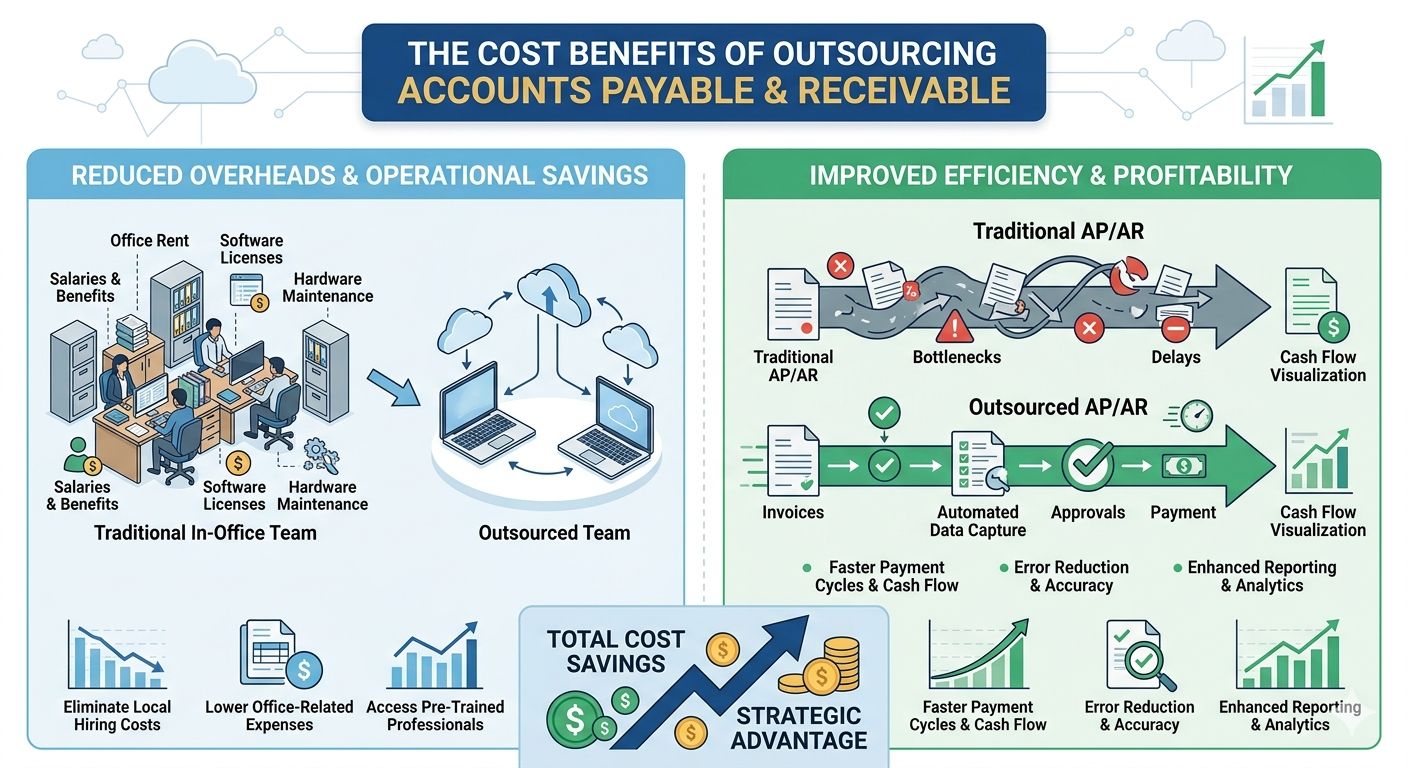
Outsourcing can reduce operational costs by 30%-50% through savings on salaries, NSSF/SHIF/PAYE, office space, software, training and compliance.
Key benefits include reduced labor costs via global labor arbitrage, eliminated infrastructure overheads, access to AI-driven and automated tools, improved accuracy and on-demand scalability.
ROI is driven by 30%-50% cost savings, 40%-60% faster processing, reduced error rates, better cash flow visibility and lower compliance risk.
Outsourced AP/AR must integrate with payroll, tax and financial reporting systems and remain eTIMS-compliant, audit-ready and aligned with KRA and IFRS requirements.
Accounts Payable (AP) and Accounts Receivable (AR) functions are essential to business continuity, yet they are among the most resource-intensive and operationally repetitive finance processes. For Kenyan businesses navigating rising compliance costs, evolving tax frameworks, and pressure on margins, outsourcing these transactional processes has emerged as a high-impact cost optimization strategy.
At Adamjee Auditors, a member of Santa Fe Associates International (SFAI Global), we advise finance leaders on how to transform AP and AR from cost centers into strategic enablers through offshore accounting and process optimization.
Why AP and AR Are Prime Candidates for Outsourcing
Quick Advisory: AP and AR are highly standardized, repetitive, and process-driven functions, making them ideal for outsourcing. Businesses can reduce costs, improve accuracy, and enhance scalability by shifting these tasks to specialized offshore teams.
Unlike strategic finance roles, AP and AR involve structured workflows such as invoice processing, payment reconciliation, collections tracking, and reporting. These processes do not require constant on-site presence but demand consistency, accuracy, and compliance.
Outsourcing allows businesses to leverage economies of scale, automation tools, and highly trained professionals without incurring the overheads of in-house teams.
Cost Breakdown: In-House vs Offshore AP/AR Functions
Quick Advisory: Outsourcing AP and AR can reduce operational costs by 30%–50%, driven by savings in salaries, infrastructure, compliance, and technology investments.
Comparative Cost Analysis (Kenya Context)
Cost Component
In-House Finance Team
Offshore AP/AR Outsourcing
Salaries & Benefits
High (monthly payroll, NSSF, SHIF, PAYE)
Significantly reduced (bundled service fees)
Office Space & Utilities
Required
Not required
Software & Systems
Purchased and maintained internally
Included in service
Training & Upskilling
Continuous cost
Managed by provider
Compliance Costs
High (KRA, IFRS updates)
Included in service
Scalability
Limited, costly to expand
Flexible and on-demand
Businesses often underestimate hidden costs such as employee turnover, recruitment, and system downtime.
A structured financial review through CFO Advisory Services can quantify your exact savings potential.
Quick Advisory: In 2026, outsourcing is no longer just about cost reduction—it is a strategic move to enhance compliance, data accuracy, and financial agility amid increasing regulatory demands.
Key Developments Impacting AP/AR
eTIMS Compliance Requirements All invoices must be validated through KRA’s eTIMS system. Offshore teams equipped with compliant systems reduce the risk of expense disallowance.
Finance Act 2025 Implications Increased scrutiny on expense recognition and documentation increases the workload for in-house teams.
SHIF and NSSF Transitions Payroll-linked accounting complexities indirectly impact cost allocations in AP/AR.
Digital Transformation Pressure Businesses must adopt automation tools—outsourcing providers already operate with advanced systems.
Quick Advisory: The primary cost benefits include reduced labor expenses, elimination of infrastructure costs, improved efficiency, and access to advanced financial systems without capital investment.
1. Reduction in Labor Costs
Outsourcing eliminates the need for:
Full-time accountants
Benefits and statutory deductions
Overtime and redundancy costs
Offshore teams operate at a fraction of the cost due to global labor arbitrage.
Specialized teams follow standardized workflows and quality control processes, reducing costly errors in:
Invoice processing
Payment scheduling
Receivables tracking
5. Scalability and Flexibility
Outsourcing allows businesses to:
Scale operations during peak periods
Reduce capacity during low activity
Expand without hiring delays
Financial ROI of Outsourcing AP/AR
Quick Advisory: The return on investment (ROI) from outsourcing AP/AR is driven by cost savings, efficiency gains, and improved cash flow management.
ROI Calculation Framework
Metric
Impact of Outsourcing
Cost Savings
30%–50% reduction
Processing Time
Reduced by 40%–60%
Error Rates
Reduced significantly
Cash Flow Visibility
Improved through real-time reporting
Compliance Risk
Lower due to expert oversight
A detailed ROI assessment can be conducted through Bookkeeping Services integrated with outsourcing strategies.
Operational Efficiency Gains Beyond Cost Savings
Quick Advisory: Outsourcing enhances operational efficiency by streamlining workflows, improving turnaround times, and enabling finance teams to focus on strategic activities.
Efficiency Improvements
Faster invoice processing cycles
Improved vendor relationships
Enhanced collections management
Real-time financial reporting
Internal finance teams can then focus on strategic planning, budgeting, and growth initiatives.
Risk Management and Compliance Advantages
Quick Advisory: Outsourcing reduces compliance risk by ensuring adherence to KRA regulations, IFRS standards, and internal controls through expert oversight.
Quick Advisory: Concerns around control, data security, and quality are largely outdated. Modern outsourcing models prioritize transparency, security, and performance metrics.
Myth vs Reality
Myth
Reality
Loss of control
Enhanced reporting and visibility
Data security risks
Secure, encrypted systems
Lower quality
Access to specialized expertise
Only for large firms
Scalable for SMEs
Integration with Core Financial Functions
Quick Advisory: Outsourced AP/AR must integrate seamlessly with payroll, tax, and financial reporting systems to ensure consistency and compliance.
Businesses should align outsourcing with:
Financial reporting cycles
Tax compliance frameworks
Payroll systems
Streamline your financial ecosystem with Payroll Services and integrated advisory.
Implementation Roadmap for Outsourcing AP/AR
Quick Advisory: A structured implementation ensures a smooth transition, minimal disruption, and maximum value realization.
Outsourcing AP and AR is no longer a tactical cost-cutting measure—it is a strategic transformation initiative. As Kenyan businesses face increasing regulatory complexity, cost pressures, and digital transformation demands, outsourcing provides a scalable, efficient, and compliant solution.
Organizations that embrace offshore financial models will benefit from reduced overheads, improved accuracy, enhanced compliance, and the ability to redirect internal resources toward growth and innovation.
The convergence of technology, global talent, and regulatory demands makes outsourcing a critical component of modern financial strategy.
Gain Clarity and Confidence in Your Finances
Navigate the complexities of compliance, tax, and financial management with a trusted partner. Adamjee Auditors, a member of Santa Fe Associates International (SFAI), provides world-class audit, tax, and advisory services to help your business achieve its goals.
Schedule a consultation with our expert team in Nairobi or Mombasa to discuss your business needs.
How much can outsourcing AP and AR save a Kenyan business?
The article states outsourcing AP and AR can reduce operational costs by 30%-50%, driven by savings in salaries and statutory deductions, office space, software, training and compliance costs.
Why are AP and AR good candidates for outsourcing?
They are highly standardized, repetitive and process-driven, involving structured workflows like invoice processing, payment reconciliation, collections tracking and reporting that need consistency and accuracy rather than constant on-site presence.
What is the ROI of outsourcing AP/AR?
The framework cites 30%-50% cost savings, processing time reduced by 40%-60%, significantly lower error rates, improved cash flow visibility through real-time reporting, and lower compliance risk due to expert oversight.
Does outsourcing AP/AR help with KRA and eTIMS compliance?
Yes. Offshore teams with compliant systems provide eTIMS-compliant invoicing, accurate tax reporting, audit-ready documentation and continuous regulatory updates, reducing the risk of expense disallowance.
Will outsourcing mean losing control or risking data security?
No. The article notes these concerns are largely outdated, as modern outsourcing models provide enhanced reporting and visibility, secure encrypted systems, access to specialized expertise, and scalability suitable even for SMEs.