For a Kenyan SME, overall revenue can look healthy while individual sales, customers, orders or projects are still destroying cash. That is why unit economics explained properly is less about accounting totals and more about understanding what happens financially each time a business sells one unit.
A “unit” could be one customer, one order, one subscription, one delivery, one room-night, one project, one treatment, one product or another measurable transaction.
Once the correct unit is defined, management can determine how much revenue that unit generates, what it costs to serve, how much contribution it produces and how long it takes to recover the cost of acquiring the customer.
The four numbers that matter most are average revenue per unit, variable cost per unit, contribution margin per unit and customer acquisition cost. For subscription or repeat-purchase businesses, customer lifetime value adds another important layer.
For Kenyan SMEs, these calculations become particularly useful when deciding whether to increase prices, discount products, hire salespeople, expand into another location, invest in marketing, introduce delivery, change suppliers or discontinue an unprofitable product.
For businesses that need to connect these calculations to broader forecasts, budgets and scenarios, see Adamjee Auditors’ Financial Modelling Kenya page:
What Are Unit Economics?
Unit economics measures the financial performance of one repeatable business unit rather than looking only at company-wide revenue and profit. The objective is to determine whether each additional sale, customer, order or project creates economic value after the costs directly associated with producing or acquiring it.
Unit economics asks a simple question:
“What happens financially when we add one more unit of business?”
Consider a Nairobi-based online retailer.
The business may report:
- KSh 10 million annual revenue
- 1,000 customers
- KSh 2 million gross profit
Those figures provide useful information, but they do not automatically explain whether acquiring another customer is profitable.
Management needs to know:
- How much does the average customer spend?
- What does it cost to fulfil that customer’s orders?
- How much gross contribution remains?
- How much did the business spend to acquire the customer?
- How often does the customer buy?
- How long does the customer remain active?
That is the purpose of unit economics.
It converts broad financial statements into an operating view that management can use to make decisions.
Why Unit Economics Matters for Kenyan SMEs
A growing SME can become financially weaker if the economics of each additional customer or transaction are poor. Unit economics helps management distinguish genuine profitable growth from growth that consumes working capital.
Revenue growth is not automatically good growth.
Suppose an SME increases monthly sales from KSh 2 million to KSh 3 million but achieves the increase by:
- offering excessive discounts;
- paying higher commissions;
- providing free delivery;
- extending customer credit;
- increasing advertising spend;
- accepting lower-margin products; or
- taking on expensive short-term financing.
Revenue has increased, but the underlying economics may have deteriorated.
This is particularly important for SMEs because cash resources are often limited.
Unit economics therefore gives owners a practical way to answer questions such as:
Should we sell more?
Which customers should we target?
Which products deserve more marketing?
Which services should we discontinue?
Can we afford to reduce our prices?
Is our customer acquisition strategy sustainable?
These questions connect operational decisions with financial outcomes.
For companies that need broader strategic support, this analysis can also form part of business advisory services in Kenya. See:
business-advisory-services-kenya
This broader advisory approach can connect operating performance, financial information and growth decisions.
The Four Numbers Behind Unit Economics
Most SME unit-economics analysis can begin with four core numbers: revenue per unit, variable cost per unit, contribution margin per unit and customer acquisition cost. The calculations should use consistent definitions so that management does not compare incompatible figures.
The four core measurements are:
- Average Revenue Per Unit (ARPU)
- Variable Cost Per Unit
- Contribution Margin Per Unit
- Customer Acquisition Cost (CAC)
Each answers a different question.
Average Revenue Per Unit
Average revenue per unit tells you how much revenue the business receives from one unit.
The basic formula is:
Average Revenue Per Unit = Total Revenue ÷ Number of Units Sold
For example, if a business generates KSh 1,500,000 from 3,000 orders:
KSh 1,500,000 ÷ 3,000 = KSh 500
The average revenue per order is therefore KSh 500.
However, management should be careful when using averages.
If some customers spend KSh 200 while others spend KSh 5,000, the average may hide significant differences between customer groups.
That is why SMEs should consider segmenting unit economics by:
- product;
- customer type;
- location;
- sales channel;
- salesperson;
- branch;
- order size;
- service type; or
- customer acquisition source.
Variable Cost Per Unit
Variable costs increase as the business produces, sells or delivers more units.
Depending on the business model, they may include:
- materials;
- packaging;
- transaction fees;
- delivery costs;
- sales commissions;
- payment processing fees;
- production labour that varies directly with output;
- outsourced fulfilment;
- product-specific licences or charges.
The exact definition depends on the business.
For example, an SME selling products for KSh 2,000 may have:
- Product cost: KSh 1,100
- Packaging: KSh 100
- Delivery subsidy: KSh 150
- Payment/transaction costs: KSh 50
Total variable cost:
KSh 1,400
Contribution before customer acquisition costs:
KSh 2,000 − KSh 1,400 = KSh 600
That KSh 600 is more useful for decision-making than simply knowing the selling price.
Contribution Margin Per Unit
Contribution margin measures how much remains after variable costs.
Contribution Margin Per Unit = Revenue Per Unit − Variable Cost Per Unit
Using the example above:
KSh 2,000 − KSh 1,400 = KSh 600
The contribution margin ratio is:
Contribution Margin Ratio = Contribution Margin ÷ Revenue × 100
Therefore:
KSh 600 ÷ KSh 2,000 × 100 = 30%
The business contributes KSh 600, or 30% of revenue, toward covering fixed costs and generating operating profit.
Fixed costs might include:
- rent;
- permanent salaries;
- accounting fees;
- software subscriptions;
- insurance;
- management salaries;
- office expenses;
- depreciation; and
- other overheads.
A high contribution margin gives the business more room to cover these costs.
Customer Acquisition Cost
Customer acquisition cost measures how much the business spends to acquire a customer.
A simplified formula is:
CAC = Sales and Marketing Acquisition Costs ÷ New Customers Acquired
Suppose an SME spends KSh 300,000 on qualifying sales and marketing activity and acquires 100 new customers.
CAC = KSh 300,000 ÷ 100 = KSh 3,000
The business therefore spends an average of KSh 3,000 to acquire each new customer.
That number becomes meaningful only when compared with the contribution generated by those customers.
Unit Economics Example for a Kenyan SME
A unit economics example becomes useful when all revenue and directly attributable costs are assigned to the same unit. For management purposes, the calculation should be simple enough to update regularly and detailed enough to support pricing, marketing and growth decisions.
Consider a Kenyan cleaning-services SME.
Suppose the company provides an average cleaning visit for:
Selling price: KSh 3,000
Direct variable costs:
- Cleaning materials: KSh 300
- Cleaner compensation attributable to the job: KSh 1,200
- Transport allocation: KSh 300
- Payment/booking cost: KSh 100
Total variable cost:
KSh 1,900
Contribution:
KSh 3,000 − KSh 1,900 = KSh 1,100
Contribution margin:
KSh 1,100 ÷ KSh 3,000 × 100 = 36.7%
Now assume the business spends KSh 2,200 to acquire an average new customer.
If the customer books only once, the initial economics are unattractive because the contribution from one booking does not cover acquisition cost.
But suppose the average customer books six times.
Lifetime contribution before other customer-level costs:
KSh 1,100 × 6 = KSh 6,600
If CAC is KSh 2,200, the customer can potentially generate substantial lifetime contribution.
This illustrates why customer retention matters.
Contribution Margin Is Not the Same as Profit
Contribution margin should not be confused with net profit. Contribution shows what remains after defined variable costs; the business must still cover fixed overheads, financing costs, taxes and other expenses before determining final profitability.
An SME might have a KSh 1,000 contribution per order but still make an operating loss.
Suppose monthly contribution is:
KSh 1,000 × 1,000 orders = KSh 1,000,000
The business then has fixed monthly costs of KSh 1.2 million.
The result is:
KSh 1,000,000 − KSh 1,200,000 = KSh 200,000 operating loss
This is why management should connect unit economics with the broader financial statements.
A business needs both:
Unit economics to understand the economics of individual transactions or customers.
Financial reporting to understand the overall financial position and performance.
For businesses that need stronger forecasting, scenario planning and decision support, financial modelling can extend these calculations into integrated projections.
Unit Economics and Break-Even Analysis
Break-even analysis connects unit economics to the total cost structure of the business. Once management knows contribution per unit and fixed costs, it can estimate the number of units required to cover those fixed costs.
The basic formula is:
Break-Even Units = Fixed Costs ÷ Contribution Margin Per Unit
Suppose:
- Fixed costs = KSh 900,000
- Contribution per unit = KSh 1,500
Break-even volume:
KSh 900,000 ÷ KSh 1,500 = 600 units
The business needs approximately 600 units to cover its fixed costs.
This becomes especially useful when evaluating:
- opening another branch;
- hiring additional staff;
- purchasing equipment;
- launching a new product;
- entering a new market; or
- increasing marketing expenditure.
Management can model how the decision changes fixed costs and the number of units required to break even.
For detailed scenario analysis, management can also use financial forecasting to test different sales, cost and cash-flow assumptions:
financial-forecasting-kenya-rolling-budgets
Customer Lifetime Value and Unit Economics
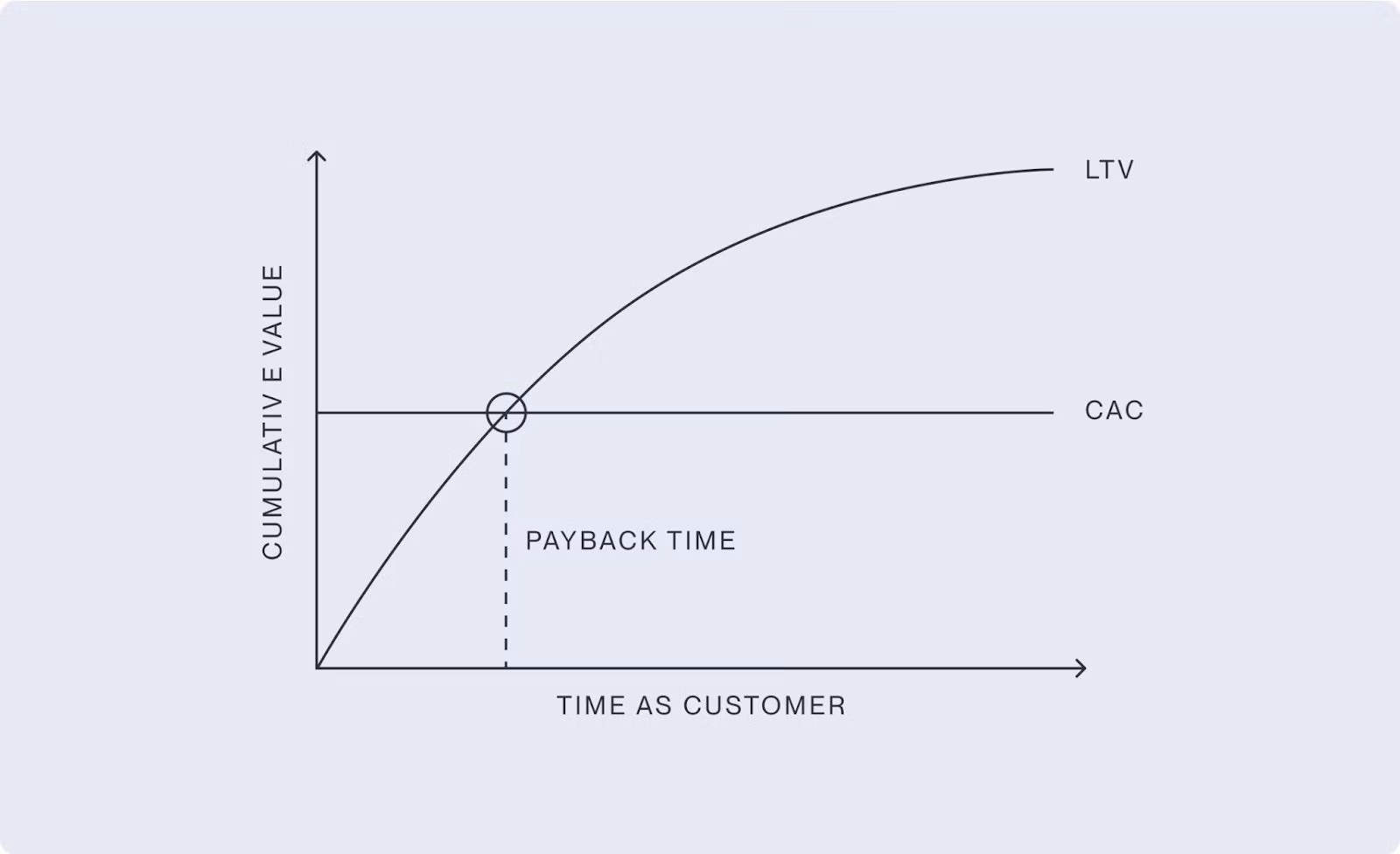
Customer lifetime value becomes important when customers purchase repeatedly. A business should compare the contribution generated over the expected customer relationship with the cost of acquiring that customer.
A simplified customer lifetime value calculation can begin with:
Customer Lifetime Value = Average Contribution Per Purchase × Purchase Frequency × Expected Customer Lifespan
Suppose an SME has:
- Contribution per purchase: KSh 800
- Average purchases per year: 5
- Expected customer lifespan: 3 years
Estimated lifetime contribution:
KSh 800 × 5 × 3 = KSh 12,000
If customer acquisition cost is KSh 2,500, management can compare the acquisition investment with the expected lifetime contribution.
However, this should not be treated as an automatic profit calculation.
The business may also need to consider:
- retention costs;
- refunds;
- bad debts;
- customer service;
- discounts;
- financing costs;
- churn;
- inflation;
- taxes;
- working capital requirements; and
- the timing of cash flows.
For more sophisticated analysis, management should model these assumptions rather than relying on one headline ratio.
How Pricing Changes Unit Economics
Pricing has a direct effect on contribution margin, but a price increase can also affect demand. SMEs should therefore test price changes using both margin calculations and realistic volume assumptions.
Suppose a product sells for KSh 5,000 and has a variable cost of KSh 3,500.
Contribution:
KSh 1,500
Now consider a price increase to KSh 5,500.
If variable costs remain KSh 3,500:
Contribution = KSh 2,000
Contribution increases by KSh 500 per unit.
But the business must also consider whether the higher price causes a significant reduction in sales volume.
Conversely, a discount may increase sales volume while reducing contribution per unit.
The correct question is therefore not:
“Will the discount increase sales?”
It is:
“Will the additional contribution generated by increased volume justify the reduction in contribution per unit?”
That is a unit-economics question.
Discounts Can Destroy Unit Economics
Discounts should be evaluated using contribution rather than revenue alone. A discount that increases order volume can still reduce total contribution if the additional sales do not compensate for the lower margin.
Consider a product with:
- Selling price: KSh 10,000
- Variable cost: KSh 7,000
- Contribution: KSh 3,000
At full price, 100 units generate:
KSh 300,000 contribution
Now the business offers a 15% discount.
New selling price:
KSh 8,500
Assuming variable cost remains KSh 7,000:
New contribution = KSh 1,500
The business now needs to sell 200 units to generate the same KSh 300,000 contribution.
This is why promotional campaigns should be evaluated on contribution rather than sales revenue alone.
Unit Economics and Customer Acquisition Channels
Different marketing channels can produce customers with very different economics. SMEs should measure CAC and customer contribution by channel rather than assuming every new customer has the same value.
Imagine an SME acquires customers through:
- Google search;
- social media;
- referrals;
- sales representatives;
- physical walk-ins;
- partnerships.
The business might discover:
| Channel | CAC | First-Purchase Contribution |
|---|---|---|
| Referrals | KSh 800 | KSh 2,000 |
| Organic search | KSh 1,200 | KSh 2,100 |
| Paid social | KSh 2,800 | KSh 2,000 |
| Sales representatives | KSh 4,000 | KSh 2,500 |
The figures should be validated using the company’s own data and consistent cost definitions.
The objective is not automatically to eliminate the most expensive channel.
A channel with high CAC could still produce customers who buy repeatedly and generate greater lifetime contribution.
The analysis therefore needs both acquisition and retention data.
Unit Economics and Working Capital
A profitable unit is not necessarily a cash-positive unit in the short term. Credit sales, inventory requirements and supplier payment terms can create a substantial gap between accounting profitability and available cash.
This is particularly important for Kenyan SMEs selling on credit.
Suppose a business makes a KSh 100,000 sale with a healthy contribution margin.
The customer pays after 60 or 90 days.
The SME may still need to pay:
- suppliers;
- employees;
- transport providers;
- utilities;
- taxes; and
- other operating expenses
before receiving the customer’s cash.
This creates a working-capital requirement.
Consequently, unit economics should ideally be reviewed alongside a working capital forecast for an SME:
Growth can consume cash even when each additional customer appears profitable.
Unit Economics by Product or Service
Company-wide averages can hide products or services that destroy contribution. SMEs should calculate unit economics at product, service or customer-segment level whenever meaningful differences exist.
Consider a company selling three products:
| Product | Revenue | Variable Cost | Contribution |
|---|---|---|---|
| A | KSh 2,000 | KSh 1,200 | KSh 800 |
| B | KSh 3,000 | KSh 2,700 | KSh 300 |
| C | KSh 5,000 | KSh 3,000 | KSh 2,000 |
Product B generates more revenue than Product A but contributes less per unit.
If management looks only at sales revenue, it could incorrectly prioritize Product B.
A contribution-based analysis provides another perspective.
Management should then consider:
- sales volume;
- customer demand;
- inventory requirements;
- capacity constraints;
- cross-selling;
- customer acquisition costs;
- strategic importance; and
- cash conversion.
The highest contribution product is not automatically the one the company should prioritize. The decision depends on the complete business model.
How Kenyan SMEs Can Build a Unit Economics Dashboard
A useful dashboard should contain a small number of consistently defined metrics that management can update monthly. The objective is not to create a complicated spreadsheet but to make economic changes visible early.
A practical SME dashboard could track:
Revenue per unit
How much revenue is generated by each transaction or customer?
Variable cost per unit
What costs increase directly when the business delivers another unit?
Contribution per unit
How much remains after those variable costs?
Contribution margin
What percentage of revenue becomes contribution?
CAC
How much does it cost to acquire a customer?
Repeat purchase rate
How frequently do customers return?
Customer lifetime contribution
How much contribution does an average customer generate during the relationship?
Churn
How quickly are customers leaving?
Break-even volume
How many units are needed to cover fixed costs?
Cash conversion
How quickly does a sale turn into collected cash?
The dashboard should ideally be connected to reliable accounting, sales and operational data.
For businesses that need senior financial oversight while building these systems, Adamjee’s CFO advisory services can provide another layer of management support:
Common Unit Economics Mistakes
Poor unit-economics analysis usually comes from inconsistent definitions rather than difficult mathematics. Management should clearly define the unit, cost categories, customer cohorts and measurement period before relying on the results.
Mixing Fixed and Variable Costs
Including all overheads in variable costs can distort contribution.
Ignoring Delivery and Fulfilment Costs
A product can appear profitable until the actual cost of getting it to the customer is included.
Using Revenue Instead of Contribution
High revenue does not necessarily mean high economic value.
Ignoring Discounts
Calculations based on list prices can overstate actual revenue.
Ignoring Returns and Refunds
Returned products can materially change the economics of a customer or transaction.
Treating CAC as a One-Time Marketing Expense
Customer acquisition costs should be measured consistently across channels and periods.
Using Company-Wide Averages
Different customer segments can have dramatically different economics.
Ignoring Cash Flow
A profitable sale made on long credit terms can still create a cash shortage.
Looking Only at One Month
Customer acquisition and retention often require cohort-based analysis over several months.
When Should a Kenyan SME Review Its Unit Economics?
Unit economics should be reviewed whenever the business makes decisions that materially affect price, volume, costs, customer acquisition or growth. It should also become part of regular management reporting once the business has enough transaction data.
A review is particularly useful when:
- launching a new product;
- changing prices;
- introducing discounts;
- entering a new county;
- opening a branch;
- changing suppliers;
- outsourcing fulfilment;
- launching paid advertising;
- hiring a sales team;
- introducing delivery;
- changing payment terms;
- acquiring another business; or
- preparing for external investment.
It is also valuable when revenue is growing but cash flow is deteriorating.
That situation can indicate that growth is consuming more working capital than the business can comfortably finance.
How Unit Economics Supports Business Strategy
Unit economics gives strategic decisions a measurable financial foundation. It helps management test whether a proposed growth strategy improves contribution, customer value and cash generation rather than simply increasing sales.
For example, a business considering expansion from Nairobi to Mombasa can model:
- expected selling price;
- local delivery costs;
- staffing costs;
- customer acquisition cost;
- expected order volume;
- repeat purchase rates;
- payment terms;
- rent and other fixed costs;
- working capital;
- break-even volume.
Management can then compare scenarios before committing capital.
This approach is particularly useful when combined with a structured business performance review, because unit-level economics can explain why overall performance is changing.
For broader strategic and operational support, businesses can also explore:
business-advisory-services-kenya
When Unit Economics Points to a Problem
Negative unit economics does not always mean a business must immediately stop selling a product or acquiring customers. It means management needs to identify whether the problem comes from pricing, variable costs, acquisition costs, retention, volume or the business model itself.
Warning signs include:
- contribution margin declining;
- CAC increasing faster than customer value;
- discounts becoming necessary to generate sales;
- customers buying only once;
- delivery costs rising faster than prices;
- product returns increasing;
- sales growing while contribution falls;
- working-capital requirements increasing rapidly;
- high-revenue products producing low contribution; or
- customer acquisition taking too long to recover.
Each problem requires a different response.
For example:
Low contribution: review pricing or variable costs.
High CAC: improve acquisition efficiency or targeting.
Low repeat purchase: investigate product quality, customer experience or retention.
High delivery costs: review logistics, minimum order values or geographic targeting.
Long collection periods: review credit terms and collections.
The value of unit economics lies in identifying the economic driver behind the problem.
How an Adviser Can Use Unit Economics With an SME
Unit economics becomes most useful when it is connected to management decisions rather than treated as an isolated spreadsheet exercise. An adviser can help management define the right unit, validate assumptions, connect operating data to financial statements and test strategic scenarios.
A business advisory engagement may use unit economics to examine:
- pricing strategy;
- product profitability;
- sales performance;
- customer profitability;
- branch economics;
- marketing efficiency;
- working capital;
- cost structure;
- growth scenarios;
- investment requirements; and
- operational performance.
This can complement broader business advisory, financial modelling and CFO advisory work.
Businesses considering investment or a change in ownership can also connect unit economics to valuation work:
The objective is to understand how the economics of customers, products and services ultimately influence sustainable business performance.
Frequently Asked Questions About Unit Economics Explained
What does unit economics mean?
Unit economics measures the revenue, variable costs and resulting contribution associated with a single business unit, such as a customer, order, product or project. It helps management determine whether additional business creates economic value.
What are the four main numbers in unit economics?
The four core numbers are average revenue per unit, variable cost per unit, contribution margin per unit and customer acquisition cost. For businesses with repeat customers, customer lifetime value is also an important supporting metric.
Why is unit economics important for an SME?
Unit economics helps SMEs understand whether growth is financially sustainable. It can reveal whether pricing, acquisition costs, variable costs and customer retention are producing enough contribution to support the company’s fixed costs and growth plans.
Is unit economics the same as profitability?
No. Unit economics focuses on the economics of a defined unit, while profitability considers the company’s full revenue and cost structure. A business can have positive unit economics and still make a net loss because of high fixed overheads.
How do you calculate contribution margin?
Contribution margin per unit is calculated by subtracting variable cost per unit from revenue per unit. The contribution margin percentage is contribution divided by revenue, multiplied by 100.
What is CAC in unit economics?
CAC, or customer acquisition cost, measures the average cost required to acquire a new customer. It should be compared with customer contribution and lifetime value rather than viewed in isolation.
Conclusion: Use Unit Economics to Understand the Economics Behind Growth
Unit economics explained simply is the discipline of understanding what happens financially every time a business acquires a customer, completes an order or delivers a product or service. For Kenyan SMEs, it provides a practical bridge between operational decisions and financial performance.
The four core numbers provide a useful starting point:
Revenue per unit → Variable cost per unit → Contribution per unit → Customer acquisition cost
From there, management can add:
- customer lifetime value;
- retention;
- churn;
- break-even volume;
- working capital;
- cash conversion;
- product-level profitability; and
- scenario analysis.
The most important point is that growth should be measured by economic value, not revenue alone.
A business that understands its unit economics can make more informed decisions about pricing, marketing, products, customers, expansion and investment.
For Kenyan SMEs building stronger financial decision-making systems, unit economics can therefore become an important part of broader business advisory, financial modelling and performance management.
Gain Clarity and Confidence in Your Finances
Navigate the complexities of compliance, tax, and financial management with a trusted partner. Adamjee Auditors, a member of Santa Fe Associates International (SFAI), provides world-class audit, tax, and advisory services to help your business achieve its goals.
Schedule a consultation with our expert team in Nairobi or Mombasa to discuss your business needs.
Nairobi Office
Park View Heights, Mombasa Road, OR Mbandu Complex, Langata Road
Phone: +254 717 908 241
Email: madamjee@adamjeeauditors.co.ke
Mombasa Office
Suite 401, Motorwalla Building, Jomo Kenyatta Road
Phone: +254 750 053 053
Email: info@adamjeeauditors.co.ke
Website: https://adamjeeauditors.com/